Global Sales of Professional Service Robots Surge 24%
117,000 Transport and logistics’ robots lead as top application
Frankfurt, Sep 30, 2026 — Global shipments of professional service robots increased by 24% to almost 250,000 units in 2025, highlighting a successful shift to commercial automation. These findings are presented in the World Robotics 2026 Service Robots report by the IFR.
“Service robots are expanding into everyday operations,” says Jane Heffner, President of the International Federation of Robotics. “Sales went up across all three segments with double-digit growth rates: professional service robots gained 24%, medical robots grew 19%, and consumer service robots surged by an impressive 37%.”
Top applications for professional service robots
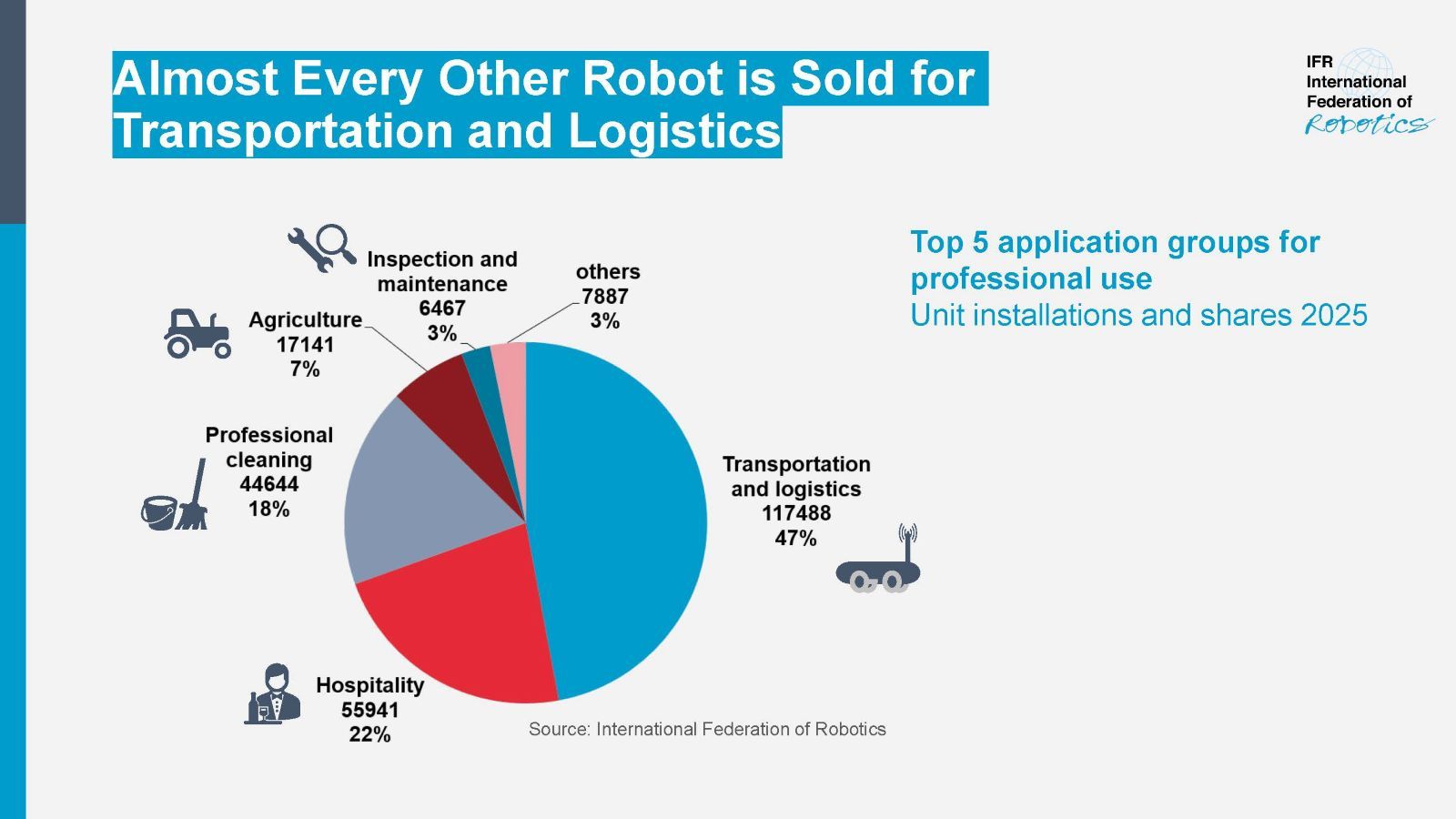
Transportation and logistics stays in the lead as top application, with 117,500 units sold in 2025. This was up 21%, and represents a market share of 47%. These robots are primarily used for transportation as well as for the automation of material flows and delivery processes.. Although traditional sales remained the main monetization channel, RaaS business models continued to grow in popularity. In the US, this already is the dominant business model.
Hospitality robots rank in second place. Machines for mobile guidance, information points in public environments, and telepresence account for the majority of these robots. The market for professional cleaning robots follows in third place, with floor cleaning as the main application in this segment.
Humanoid Robots
Humanoid robots, which are designed to resemble humans and operate in human-centric environments, are gaining massive attention for their potential flexibility. While recent advances in AI, sensors and control systems have enabled impressive pilot projects, most current applications remain specialized and often require human teleoperation. In 2025, about 7,000 units of full-size humanoids (above 140 cm) were sold globally. These robots are intended for commercial and professional applications beyond R&D and entertainment.
Key challenges such as safety standards, high training and maintenance costs, and the lack of a strong business case, particularly in industrial settings, continue to limit widespread adoption. For humanoid robots to become practical everyday tools, further progress in intuitive programming, robust manipulation, economic scaling, and standardized safety is essential.
“In a special chapter of the World Robotics 2026 report, we provide a comprehensive overview about humanoids as the robotics newest market,” says Dr. Werner Kraus, Chair of the IFR Service Robot Committee.
Robots for consumer use
Consumer service robots have primarily consisted of domestic robots aimed at the mass market. Overall sales of consumer robots increased by 37% to almost 34.2 million units in 2025. Key trends include automating household tasks, integrating artificial intelligence and connecting to smart home systems.
Medical robotics
With 8,400 units sold and a growth rate of 57 % surgical robots are the main driver of growth in the medical robotics market, reflecting their increasing adoption in clinical practice. The transition from technological development to commercial deployment has gained significant momentum over the past decade. This is driven by advances in robotics, improved clinical outcomes, and growing acceptance among healthcare professionals
IFR Position Paper on Service Robots
Last week we published our position paper "Service Robots - Impact of Robots on Human Life". It examines how service robots are addressing labor shortages, improving productivity, and supporting healthcare, hospitality, agriculture, cleaning, security, and many other sectors.
Contact
International Federation of Robotics
PRESS OFFICER
Carsten Heer
phone +49 (0) 40 822 44 284
E-Mail: [email protected]