Service Robots’ Impact Human Life
New IFR Position Paper published
Sep 24, 2026 — Professional service robots are moving from niche applications to everyday operations, helping organizations address labor shortages, demographic change, and growing service demands through advances in AI, autonomy, and human-robot collaboration.
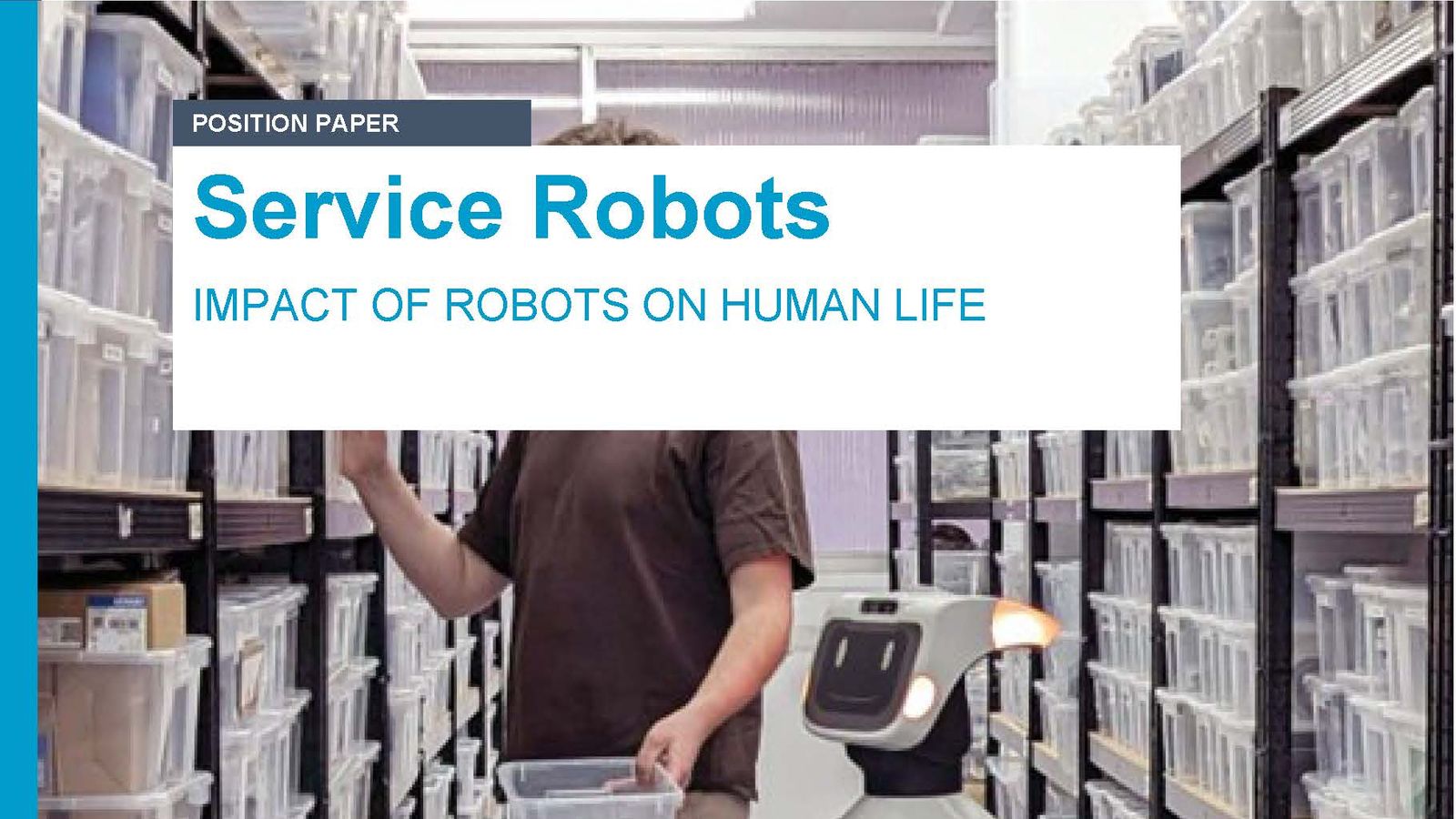
A new position paper published by the International Federation of Robotics examines how service robots are addressing labor shortages, improving productivity, and supporting healthcare, hospitality, agriculture, cleaning, security, and many other sectors.
Advances in artificial intelligence, perception systems, and autonomous navigation are enabling service robots to operate in increasingly dynamic environments. As robots become more capable, affordable, and easier to deploy, service robotics is entering a new phase of commercialization, with growing adoption across commercial and institutional settings.
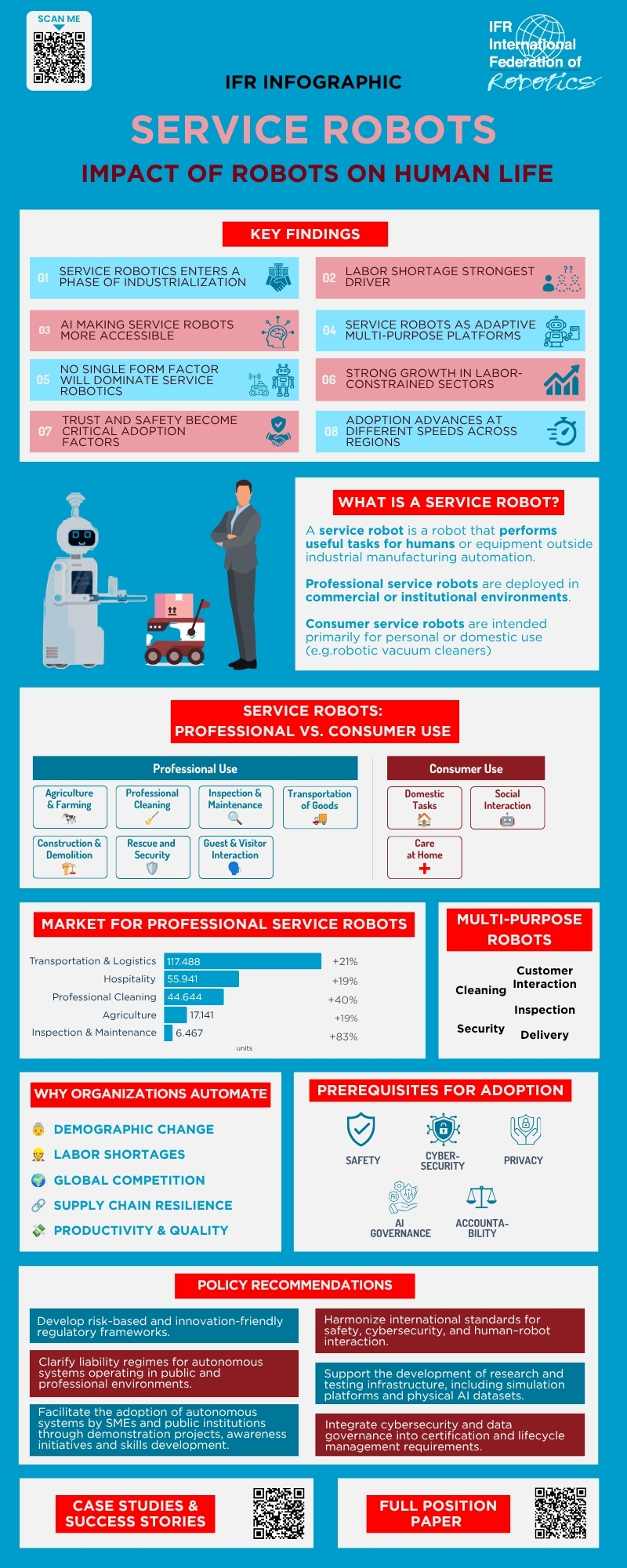
Service robots are increasingly helping organizations respond to workforce shortages, demographic change, and rising demand for services. Rather than replacing people, robots are supporting employees by taking over repetitive, physically demanding, hazardous, or time-consuming tasks, allowing workers to focus on activities that require human judgement, creativity, and interpersonal interaction.
The paper identifies labor shortages as the strongest driver of service robot adoption. Aging populations and declining birth rates are reducing the available workforce in many economies while demand for healthcare, hospitality, logistics, and public services continues to grow. Service robots can help organizations maintain service quality and operational resilience by filling labor gaps where qualified personnel are increasingly difficult to find.
Artificial intelligence is also transforming service robotics. AI-powered systems are evolving from specialized machines into adaptive, multi-purpose platforms capable of handling a broader range of tasks with less programming effort. Advances in natural language interaction, computer vision, sensor fusion, and autonomous navigation are making robots easier to use and deploy in environments shared with the public.
At the same time, the IFR paper highlights that the future of service robotics will not be dominated by a single type of robot. Mobile robots, stationary systems, drones, legged robots, and emerging humanoid platforms all have different advantages depending on the application. The most successful robotic solutions will be those that best address specific customer needs while meeting requirements for safety, reliability, and economic viability.
As service robots become more common in hospitals, hotels, airports, retail environments, and public facilities, trust and safety are becoming critical factors for adoption. The paper stresses the importance of cybersecurity, privacy, responsible AI, clear accountability frameworks, and safe human-robot interaction. Building public trust will be essential as robotic systems become more autonomous and integrated into daily life.
Service robotics is poised for sustained long-term growth.
Download this and all other IFR Position Paper for free*.
*requires registration