
Valk Welding Robotic Welding Installations at Volvo Construction Equipment
Nov 11, 2026 — Volvo Construction Equipment (Volvo CE) has implemented new robotic welding installations supplied by Valk Welding as part of its production of load-carrying welded components for articulated haulers. These components are safety-critical and place very high demands on weld quality, repeatability, process stability, and capacity.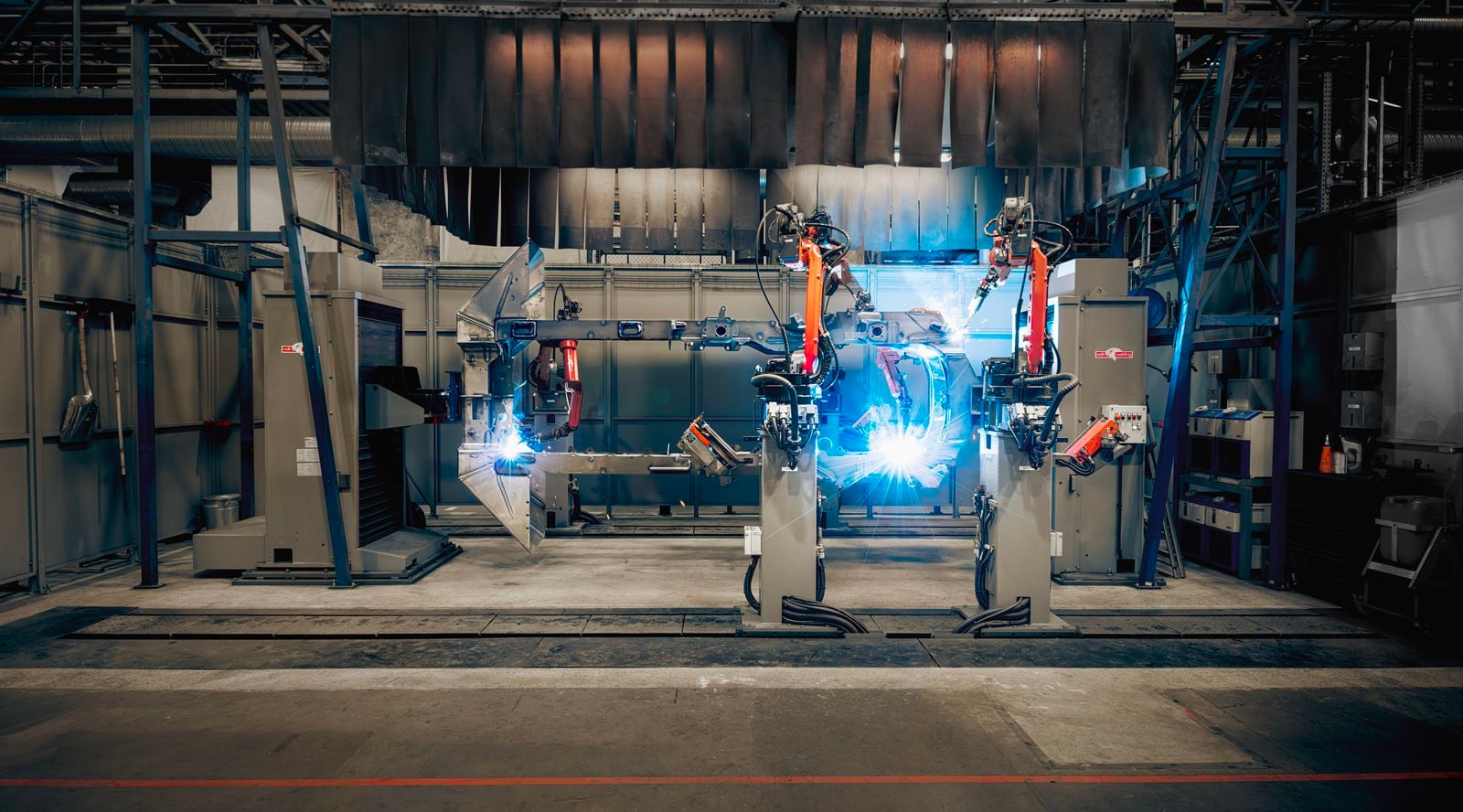
One of the new robotic welding stations at Volvo CE Braås: where offline programming, real-time data, and automated execution come together in a single connected workflow. © Volvo
At the same time, the production environment is characterized by a wide product mix and frequent product changes, making flexibility and robustness essential. Against this backdrop, robotic welding is a key enabler for meeting quality and volume requirements while also contributing to a safer and more attractive working environment.
The installation is in a production area dedicated to welding large structural components for articulated dump trucks. The parts are primarily manufactured from thick steel plates, typically ranging from 6 to 20 mm in thickness. The application involves large, heat-intensive welds, strict structural and dimensional requirements, and unavoidable variations originating from material tolerances, tack welding, and fixturing. In this context, robotic welding is essential to achieve a stable and repeatable process and to manage both complexity and production volume over time.
Before the project was initiated, Volvo CE operated a robotic welding system that was approximately twenty years old. Although automated, the solution no longer met modern requirements for flexibility, digitalization, or long-term sustainability. Programming new or modified products required significant time and effort, program maintenance was extensive, and it was difficult to keep programs synchronized across parallel welding cells. Capacity limitations restricted further automation, maintenance demands were increasing due to system age, and the lack of structured production data made systematic analysis and improvement challenging. Furthermore, introducing new products into the system was time-consuming. These factors together formed the basis for a comprehensive modernization initiative aimed not only at replacing worn equipment, but at taking a decisive technological step forward.
The objectives of the investment were defined with a strong focus on long-term value creation. Volvo CE aimed to increase welding capacity without expanding floor space, primarily by increasing the number of robots per cell. Shorter lead times for new and modified products were a key target, as was the transition to fully offline programming. Another important goal was to enable the use of identical robot programs for the same product across parallel welding cells, supported by improved digital monitoring and performance follow-up. While productivity improvements were important, the overarching ambition was to establish a future-proof welding platform that could be further developed over time.
The new solution consists of Valk Welding robotic welding cells adapted for large frame welding applications. A central element of the system is full support for offline programming using DTPS, combined with integration to the Manufacturing Information System (MIS) and Shop Floor Control (SFC). Compared to the previous installation, the new solution represents a major step change. Robot programs are now created, simulated, and validated entirely offline, without impacting production. Program management is handled centrally on a server, providing full traceability of changes and ensuring that the latest approved version is always used when production starts. In addition, the number of robots per cell has increased from two to four, significantly improving capacity and throughput. The system also offers a much higher level of connectivity, enabling the collection and analysis of detailed production data.
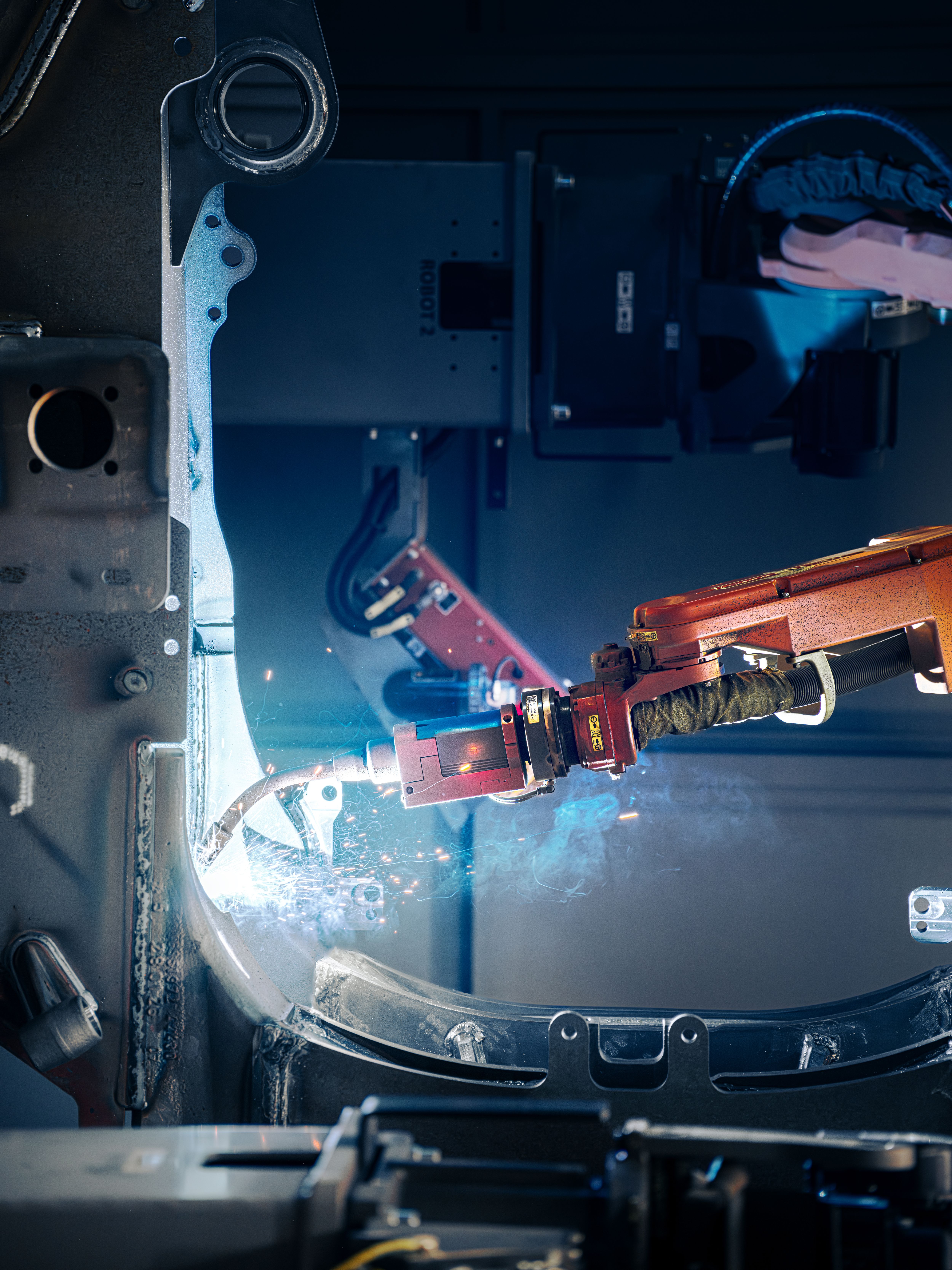
Welding large, load-bearing components presents specific challenges related to distortion, dimensional accuracy, and consistent weld quality. To manage process variation effectively, the solution relies on accurate cell and robot calibration, seam finding and seam tracking functions, and adaptive welding strategies suitable for thick plate applications. These capabilities are essential for maintaining quality and dimensional accuracy despite inherent variations in materials and assembly conditions.
The Manufacturing Information System, MIS, is primarily used for real-time production monitoring, with particular focus on the analysis of production stops. By systematically identifying and following up on recurring stop causes, Volvo CE has been able to improve cell availability and overall process stability. Shop Floor Control supports the interaction between offline programming and production execution, enabling programmers to upload programs to the server and operators to start jobs in a structured and controlled manner.
From order placement to start of production, the project duration was slightly over one year. During execution, several challenges had to be addressed, including training personnel on a new robot brand, building competence in offline programming, and transitioning from a traditional working method with on-cell programming to a fully digital approach. Another important learning area was the management of welding deformation effects when increasing the number of robots per cell from two to four. These challenges were overcome through focused training, close collaboration between partners, and adjustment of established work practices. This transparency not only improves control, but also changes how decisions are made - shifting from reactive problem-solving to proactive management.
After installation and ramp-up, the benefits of the new solution have become clear. Process stability has improved, supported by real-time data and systematic deviation handling. Higher accuracy in calibration and offline programming has reduced production disturbances, and increased automation capability has significantly reduced manual welding time. Together, these improvements have led to higher productivity and more predictable production performance.
Looking ahead, Volvo CE views robotic welding and digitalized production as central elements of its long-term manufacturing strategy. Future development will focus on expanded use of production data, further development of welding processes in close cooperation with other functions, and continued advancement of offline programming and digital working methods.
In conclusion, the implementation of Valk Welding robotic welding cells has provided Volvo CE with a modern, scalable, and future-proof welding platform. Beyond increased capacity and productivity, the solution has enabled new digital workflows and improved process stability, creating a solid foundation for continued development of automated and data-driven manufacturing. From Volvo CE’s perspective, the project represents a strategic investment that will support manufacturing operations for decades to come.

