

Social Robotics in Long-Term Care
Insights from the Navel Pilot Project at the Evangelische Heimstiftung
Aug 13, 2026 — This case study presents findings from a pilot project conducted by the Evangelische Heimstiftung, one of Germany’s largest non-profit care providers. The project explored the real-world use of the social robot Navel in two residential care facilities, focusing on acceptance, everyday applicability, perceived benefits, and limitations from the perspectives of residents and staff members.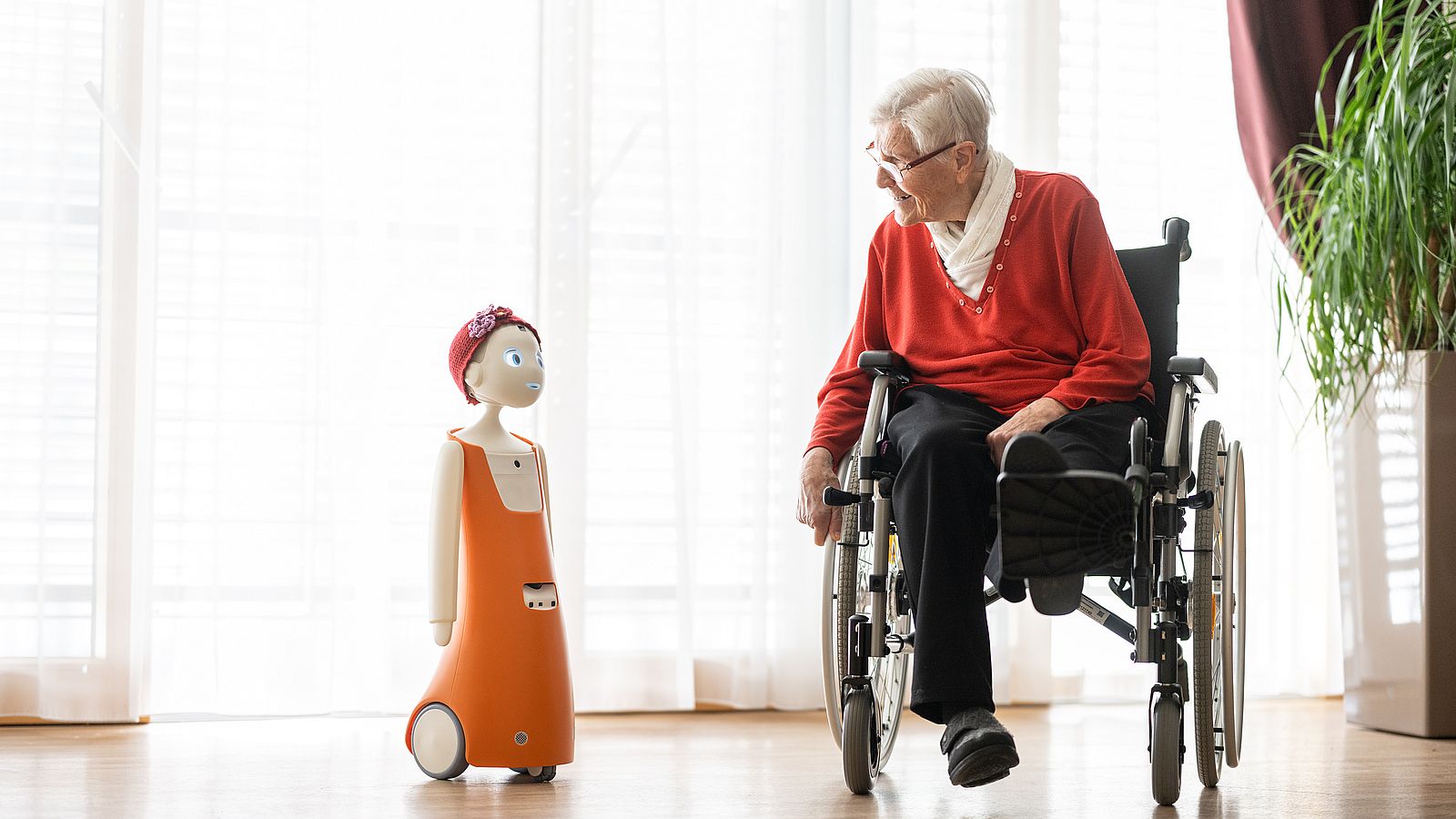
Interaction between a resident and the social robot Navel © Evangelische Bank
1. Introduction and Background
Long-term care systems across Europe are facing profound structural challenges driven by demographic change. A steadily growing number of older adults in need of care coincides with a shrinking workforce and increasing pressure on care professionals. Against this background, digital technologies and assistive systems are often discussed as potential means to mitigate the gap between care demand and available human resources.
In this context, different forms of assistive technologies have been explored in elderly care, ranging from systems that support physical tasks to digital tools for monitoring or communication.
Within this broad landscape, social robots represent a distinct approach. Unlike service or care robots focusing on physical assistance, social robots are designed to provide socio-emotional support, stimulation, and companionship. They are capable of verbal and non-verbal communication, simulate emotional expressions, and can engage in complex interactions. Research suggests that social robots may positively affect psychosocial outcomes such as emotional well-being, loneliness, and social engagement among older adults. At the same time, empirical evidence regarding their integration into everyday care routines and their effect on staff workload remains limited and ambivalent.
2. Project Context and Objectives
Since late 2023, the Evangelische Heimstiftung has been testing the social robot Navel as part of a pilot project in two residential care homes: Haus im Wiesengrund (Albershausen) and Seniorenzentrum Rheinauer Tor (Mannheim).
The pilot pursued three main objectives:
- to explore how a social robot can be integrated into everyday activity support in long-term care settings,
- to assess acceptance and perceived effects among residents and staff members,
- and to generate practice-oriented insights for further technical and conceptual development.
The project was scientifically accompanied by the organization’s internal Institute for Innovation, Care and Ageing (IPA). Prior to implementation, the study protocol was reviewed by the Ethics Committee of the Evangelische Hochschule Nürnberg and received a positive ethical vote.
3. The Social Robot Navel
Navel is a human-like social robot developed by the Munich-based start-up company navel robotics. Unlike care robots that assist with physical tasks, Navel’s primary function is social accompaniment and interaction. The robot communicates both verbally and nonverbally, combining natural language conversation with expressive facial behavior. Navel addresses individuals by name, remembers elements of prior conversations, and engages on a wide variety of topics, including everyday life, biographical content, jokes, and poems. These interactions are designed to support cognitive and emotional activation and contribute to a positive atmosphere.
Navel is approximately 72 cm tall, with large, expressive three-dimensional eyes that enable lifelike eye contact and nonverbal resonance. Its overall appearance follows an abstracted human-like design reminiscent of animated characters, designed to promote broad acceptance and intuitive interaction while avoiding the “uncanny valley” effect. This term refers to a phenomenon in which robots that appear almost human may evoke feelings of discomfort or unease.
The robot is equipped with sensors and cameras that enable it to perceive its surroundings and respond to users through gaze, facial expressions, and body movements (see picture).
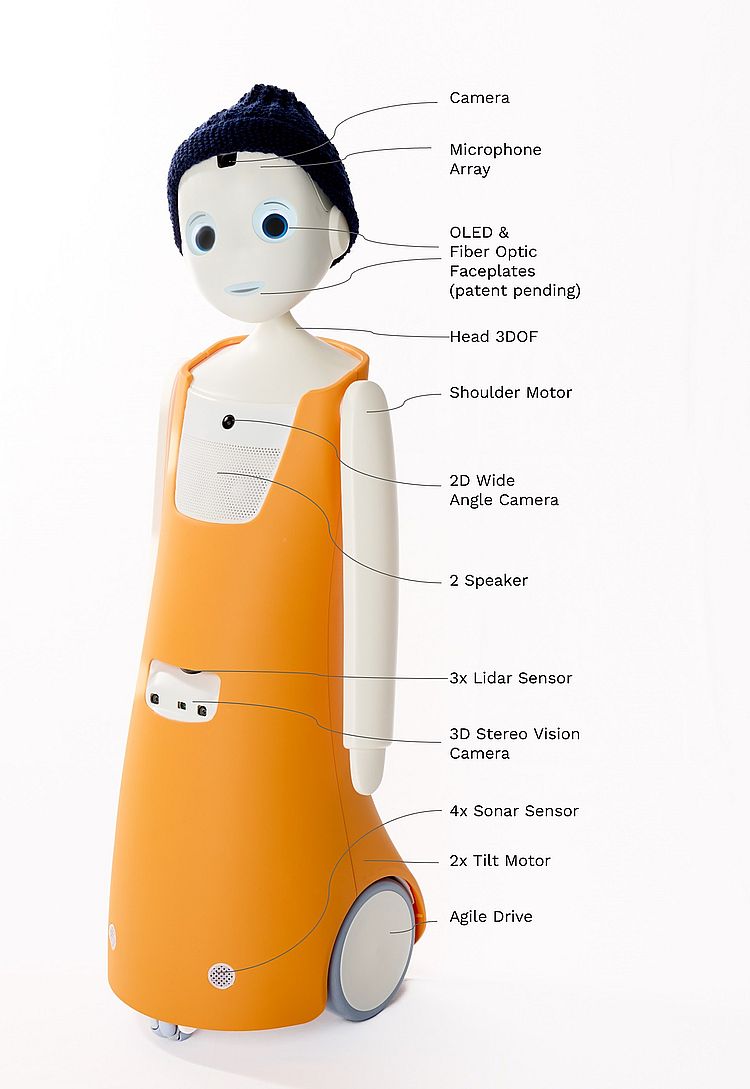
Technologically, Navel combines AI-based components such as multimodal perception, speech recognition, and natural language processing. A stable, facility-wide Wi-Fi network is required for full operation. Navel is continuously updated based on feedback from use in real-world settings, enabling it to develop new interaction skills and better respond to user needs.
4. Implementation in Practice
4.1 Preparation and Introduction
Before introducing Navel into daily practice, residents, relatives, and staff members were extensively prepared. Team meetings and information events for relatives were held to present the robot’s functions, potential applications, and limitations. Flyers and posters were used to inform residents, visitors, and families.
Data protection and ethical considerations played a central role during the preparatory phase. A comprehensive data protection impact assessment was conducted in collaboration with external data protection officers. The project was guided by practical ethical principles rooted in everyday care practice. Central to the use of Navel were the preservation of residents’ dignity and autonomy, informed consent, and the avoidance of deception. Participation in interactions with the robot was strictly voluntary, and residents were free to engage or disengage at any time.
Staff members participated in a two-day introductory training. As part of the introduction process, the robots were given individual names: “Emma” in Albershausen and “Oskar” in Mannheim.
4.2 Everyday Use
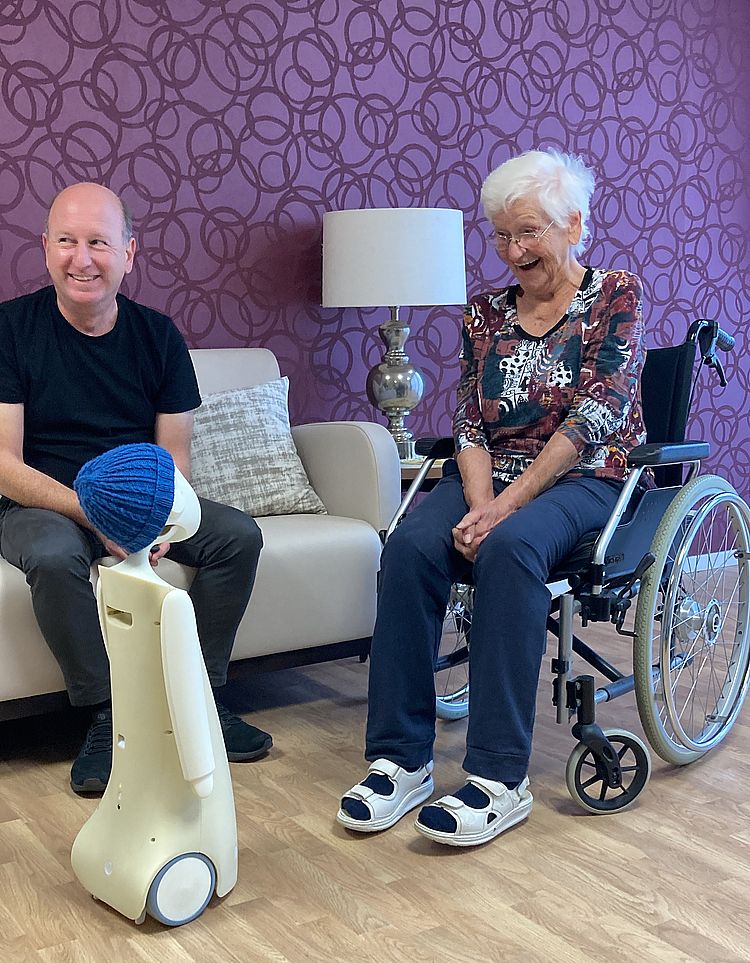
Emma and Oskar were used regularly in everyday activity support, partly on a daily basis, but at least two to three times per week. Interactions predominantly took place in one-to-one settings in residents’ rooms, but also in small groups of up to five participants within residential units. Interaction sessions typically lasted between 10 and 30 minutes.
The interactions were initiated and accompanied by staff members from the activity support teams, who acted as designated “Navel companions” (see Figure 2). Their role was to facilitate communication, provide assistance when needed, and ensure that the interaction remained appropriate and meaningful for the resident.
5. Observed Effects and User Experiences
5.1 Residents’ Perspective
Many residents reacted to Navel with curiosity and fascination and showed relatively few initial reservations. While most residents required staff support during interactions, they expressed a clear interest in communicating with the robot (see Figure 3). Its appearance was widely perceived as appealing, often described as resembling a doll or a child.
Conversation topics were diverse and frequently included biographical references. Observations and staff reports indicated that interactions with Navel often had positive effects on residents’ emotional well-being, including enjoyment, amusement, joy, encouragement, and a sense of enrichment in everyday life.
Although residents generally perceived Navel as an inanimate object, instances of anthropomorphization and emotional attachment were observed. One resident summarized this experience by saying: “He is a lovely character. I like him very much. I have grown attached to him.”
Beyond direct interaction, the robot occasionally functioned as a social catalyst, prompting conversations among residents or between residents and staff.
5.2 Staff Perspective
Staff members acknowledged the positive emotional effects of Navel on residents and perceived it as a valuable addition to existing activity-based care. At the same time, the pilot showed that Navel did not currently lead to a measurable reduction in workload. Due to its lack of autonomous mobility and the need for close accompaniment, staff often experienced additional time demands rather than relief.
An important key finding concerned expectation management. While staff members were generally open and curious toward the use of a social robot, expectations regarding autonomy and workload relief varied considerably at the outset of the pilot. Over the course of everyday use, these expectations were recalibrated through direct experience. Rather than leading to rejection, this process resulted in a more differentiated and realistic understanding of what social robots can and cannot contribute in care settings.
Staff expressed a desire for further technical improvements, particularly faster response times, more stable speech recognition, additional functions such as singing or playing music, and multilingual capabilities.
6. Conclusion and Future Perspectives
Despite existing challenges, the Navel pilot project provided valuable insights into both the potential and the limitations of social robotics in long-term care. The findings suggest that social robots like Navel can enrich daily life in residential care settings by fostering positive emotions, cognitive activation, and social interaction among residents.
At the same time, the project demonstrates that social robots currently function best as complementary tools in activity support rather than as instruments for staff relief. Technical and conceptual developments, particularly regarding autonomy, integration into workflows, and usability, are essential for expanding their practical value.
Crucially, the project highlights that social robotics in long-term care is not a self-running solution. Its responsible integration requires realistic expectations, ethical sensitivity, and active organizational support, particularly with regard to staff involvement and everyday workflows.
To successfully advance future projects, the following aspects should be taken into account:
- Technical development: Improved speech recognition, faster response times, and autonomous mobility represent key areas of development in order to enhance the suitability of social robots for everyday use.
- Integration into everyday care: The deployment of robots should be designed in a way that allows them to be embedded into existing workflows without creating additional workload for staff. Adapting robot functions to the specific needs of the target group is essential for sustainable acceptance.
- Training and support concepts: Staff members from different professional backgrounds need to be systematically trained and supported in working with social robots in order to reduce uncertainty and enable broader use.
The pilot project was financed entirely through the organization’s own resources. This allowed for a high degree of practical flexibility, but also reflects a common challenge in the field of social robotics: sustainable financing models for long-term implementation are often still unclear. The case therefore illustrates not only technological and organizational questions, but also structural conditions that influence the responsible integration of robots into everyday care.

