

Revolutionizing Solar Farm Construction
Using In-Field Mobile Robotics
Aug 25, 2026 — As the global push for renewable energy accelerates, future-focused energy companies are increasingly geared toward leveraging advanced technology to automate the complex, labor-intensive process of constructing large-scale solar farms.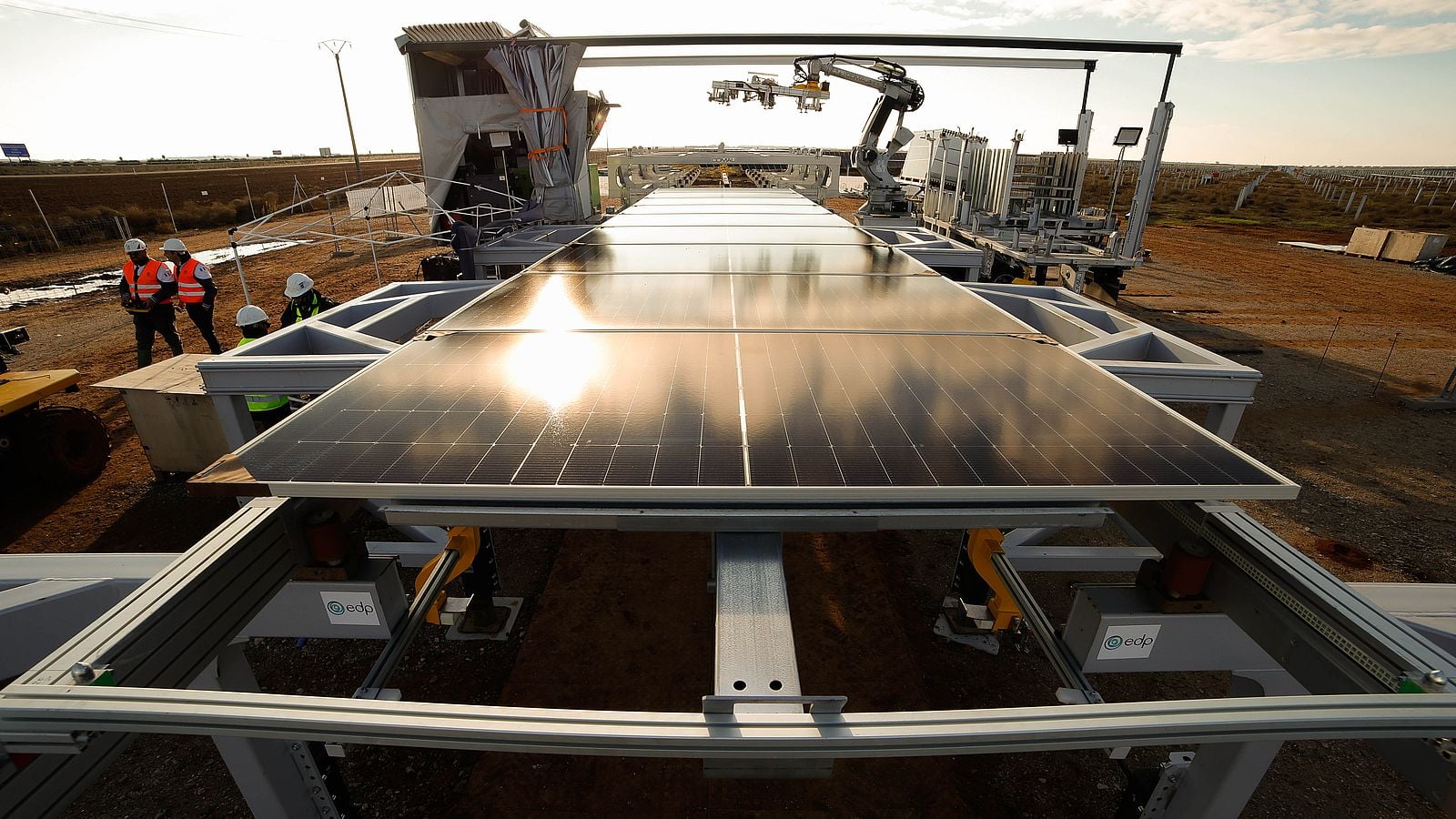
Hyperflex pre-assembles a portion of the solar tracker, which measures up to 12 m long and 5 m wide. © Daniel Mora
Traditional methods require significant manual labor and are subject to cost fluctuations and often face delays due to workforce constraints or unpredictable logistics.
In response to these challenges, EDP, a global leader in the renewable energy sector with an ambitious portfolio of solar projects around the world and a strong focus on innovation, tested Comau's unique mobile robotic factory to automate the assembly and installation of photovoltaic (PV) panels in the field. The project would mark the first time EDP would use advanced automation to build one of its photovoltaic solar parks under real-life installation conditions.
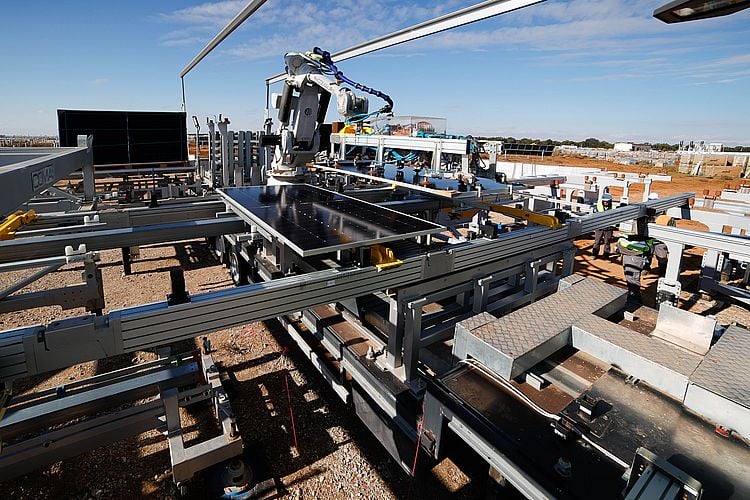
After defining the project's initial scope, the joint engineering team needed to develop an innovative approach that would give EDP the required flexibility while ensuring maximum precision and repeatability during the installation process. The companies agreed to use Comau’s Hyperflex rover to install 3MW of EDP’s 122MW capacity solar park in Peñaflor, Valladolid, Spain. The primary focus was evaluating Hyperflex’s impact on installation speed, worker safety, and overall operational efficiency. In tandem, Comau’s MATE-XT wearable exoskeletons would be used to provide ergonomically assisted support for workers during overhead and repetitive tasks. Indeed, the multi-faceted program aimed to validate a new approach to solar farm construction that could make it faster, safer, and more efficient.
Hyperflex is a temporary mobile factory that automates the manufacturing, transportation, and installation of the torque tube, transversal beam, and PV module in a single, streamlined operation. By collapsing multiple steps of solar farm assembly into a fluid and highly automated workflow, Hyperflex allows EDP to gain centralized control of the entire process while creating a new, KM 0 logistics flow directly in the field.
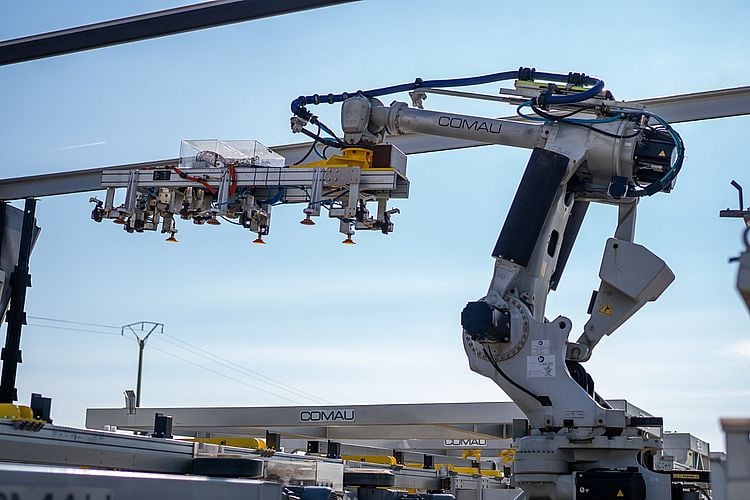
Fitted with Comau robotics, Artificial Intelligence, caterpillar tracks and Comau’s patented lifting equipment, Hyperflex improves the photovoltaic value chain at a plant level. Its optimized mix of manual and automated processes, during which human operators work alongside the robot in complete safety thanks to advanced laser scanning techniques, facilitates EDP’s green energy production while improving the operators' working conditions. The in-field operators also play a fundamental role in quality control and process management as part of the comprehensive solution. Finally, because the entire system is housed within a semi-trailer, it is highly mobile and can be easily deployed in different geographic locations and during diverse atmospheric conditions.
Although the trial's primary goal was to verify Comau’s capability to automate solar tracker assembly and installation while improving project timelines and logistics efficiency, protecting worker safety, ensuring zero work-related incidents, and maintaining high overall installation quality were equally important criteria. Here, Comau’s MATE-XT wearable exoskeletons were used to improve the ergonomics and precision of manual tasks such as the tightening of overhead bolts. Lightweight and highly breathable, MATE-XT supports the operator’s upper body movements while executing repetitive overhead tasks, thus helping reduce fatigue and increase the quality of manual operations. The only EAWS-certified exoskeleton for effectively lowering the biomechanical risk for workers, MATE-XT reduces shoulder muscle activity by 30% while also reducing the perceived effort felt by workers. This, in turn, can help workers increase accuracy during overhead tasks as well as their execution speed, by up to 27% and 10%, respectively.
Looking to validate the Hyperflex system for future large-scale deployment, Comau and EDP engineers carefully monitored performance metrics, operational reliability, and ease of use. They found that the on-site manufacturing and installation successfully eliminated the logistical complexities of transporting pre-assembled solar components from a remote facility. This ultimately translates to reduced lead times, enabling real-time adjustments based on site conditions, and lower overall costs. Beyond the efficiency and cost-saving potential, Comau’s solution improved worker safety and ergonomics. Manual solar panel installation involves physically demanding, repetitive tasks, which can lead to musculoskeletal injuries, fatigue, and other health issues. Hyperflex is designed to minimize these risks by automating the most strenuous aspects of the process. To further enhance worker well-being, integrating MATE-XT has provided passive mechanical support for the workers’ shoulders and arms, reducing muscle fatigue and reducing the risk of repetitive strain injuries. MATE-XT also allows operators to maintain their performance levels over extended periods while benefiting from greater comfort and reduced physical exertion.
One of the most significant outcomes of the collaboration, in addition to the productivity benefits, is that there have been zero work-related incidents and zero quality defects with Hyperflex, highlighting the precision and reliability of the automated assembly process. Furthermore, the combination of mobile robotics and ergonomic support technologies has helped create a working environment that prioritizes both efficiency and worker well-being, representing a universal objective for industrial-scale solar farm construction.
From an economic and environmental perspective, Hyperflex can help EDP reduce the cost and time required to deploy solar farms by optimizing the labor-intensive aspects of their construction, reducing logistical expenses, as well as improving overall process efficiency. Additionally, automated installation helps reduce waste, minimize resource consumption, and ensures a more sustainable and scalable approach to expansion of renewable energy.
The successful deployment of Hyperflex in EDP’s Valladolid solar park represents an important milestone in making clean energy more accessible. The comprehensive solution has allowed companies to validate a new paradigm in automated solar farm construction with zero work-related incidents, zero quality defects, and solid efficiency improvements. This important milestone will allow them to refine the system, enhance its process optimization capabilities, and expand its deployment to larger solar farms within Europe and beyond.

