
Precision in outdoor use: How ZwickRoell is pushing the boundaries of intralogistics automation
Nov 11, 2026 — The automation of material flows is now a key lever for competitiveness. But while digital transformation is well advanced in air-conditioned halls with good (completely flat/smooth) floors, autonomy often ends abruptly at the hall threshold. Thresholds, ramps, and outdoor weather conditions have long been considered barriers that classic driverless transport systems (AGVs) and ARMs could not overcome.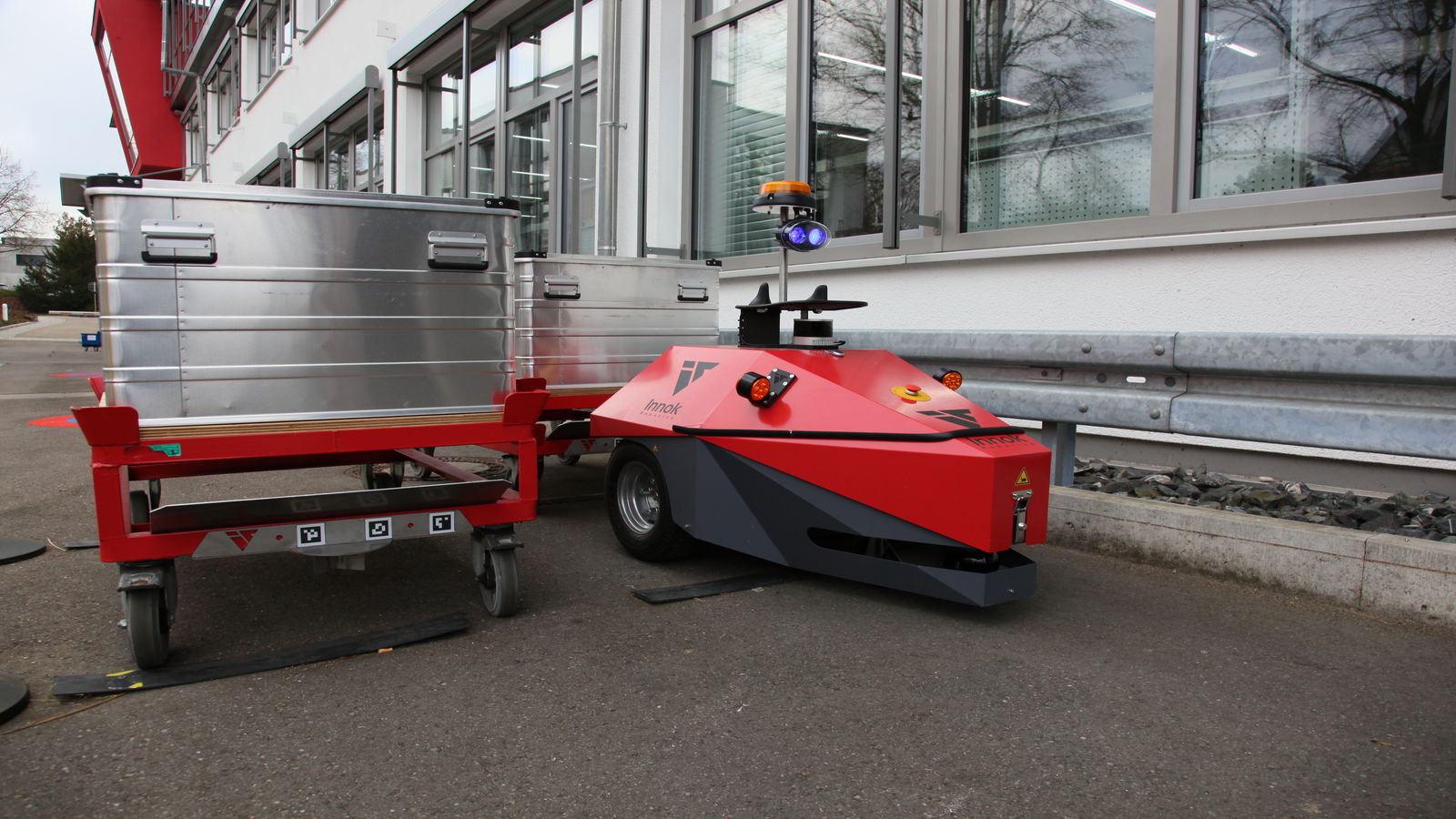
The global market leader for materials testing machines, ZwickRoell from Ulm, together with Innok Robotics, is demonstrating that these hurdles are a thing of the past. The focus is on a system that moves loads and heralds a new era of flexibility in "brownfield" sites.
The challenge: when the standard reaches its limits
For ZwickRoell, precision is its core business. The company builds testing systems for the aerospace, medical technology and automotive industries. But as precise as the machines are, logistics on the factory premises have long been complex. Transporting important test components between assembly halls and the logistics centre required a great deal of manual effort and made it difficult to plan operating times. Forklift drivers had to move materials in all weather conditions – a task that tied up human resources and was difficult to integrate into digital processes.
The problem in established industrial structures is multifaceted. Existing routes are often not designed for conventional robot navigation. There are no walls for laser navigation, the asphalt is uneven and GPS coverage can vary between reinforced concrete buildings. In addition, there are inclines that simply overwhelm conventional indoor AMRs with their small wheels.
The INDUROS: A powerhouse for any terrain
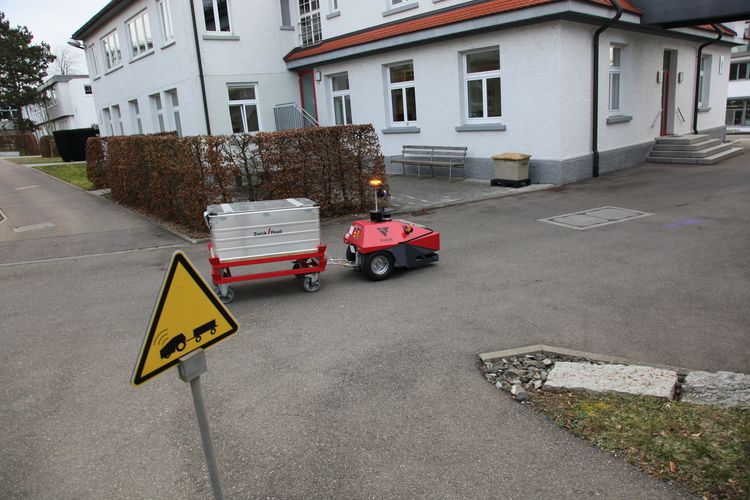
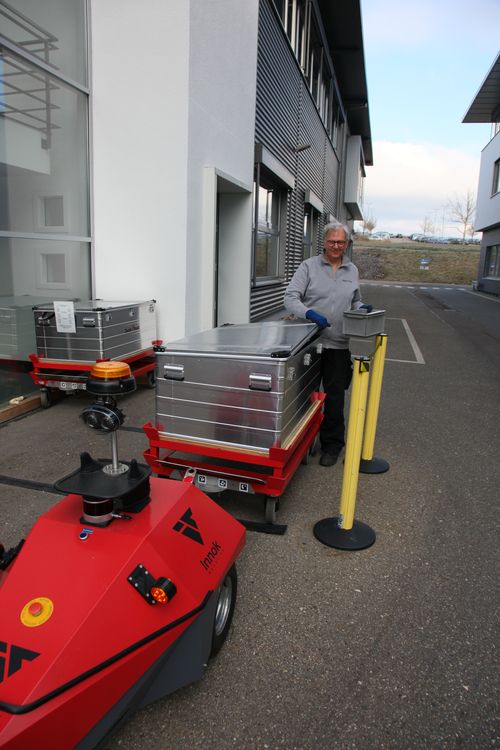
To close this gap, ZwickRoell relies on the INDUROS from Innok Robotics. The robot is not a delicate indoor device, but a robust powerhouse for indoor and outdoor use. With a pulling load of up to 1,300 kg (INDUROS 1300 model), it pulls pallet trucks, mesh boxes or, as in this example, boxes with spare parts safely across the site.
Technically, the INDUROS is a response to physical limitations. A stable chassis and large drive wheels ensure that cobblestones, potholes, or expansion joints on gates are no obstacle. Where other systems switch off their sensors in rain or snow, the INDUROS continues to work reliably thanks to its weatherproof housing, special sensor technology, and proprietary AI software. At ZwickRoell, it is a stable logistics constant that operates independently of shift times.
Intelligence instead of reflectors: Innok Hybrid Navigation
A critical issue in the introduction of AMR is the infrastructure required. Many systems need reflectors or magnetic strips for orientation. In a dynamic outdoor environment, this is hardly feasible. Innok Robotics' solution is based on "hybrid navigation". This involves merging data from LiDAR scanners, odometry, and AI-based data processing in real time.
This enables the robot to recognise its surroundings in a similar way to a human being. It sees static obstacles as well as passers-by or forklift trucks and reacts without delay. If an obstacle blocks the way, the software can autonomously use an alternative route or signal to the obstacle to clear the way. This navigation in unprotected outdoor spaces is the decisive technological advantage over classic towing systems.
Software stack: from cockpit to intuitive control
The true strength lies in the "Innok Cockpit" software platform. This acts as the central nervous system and digital twin of the robot environment. This is where travel routes are defined and communication with the infrastructure is coordinated. The INDUROS communicates directly with the high-speed doors at ZwickRoell: it "asks" the door for permission, waits for clearance and only passes through when safety is guaranteed.
The "BayControl" operating concept is particularly noteworthy. The target group in production is skilled workers who need a functioning tool. Employees can call the robot or assign targets via an intuitive tablet interface. This "mobile-first" approach has contributed significantly to acceptance at ZwickRoell. The robot is perceived as a helpful colleague.
Scaling through modern fleet management
As ZwickRoell continues to develop its automation strategy, fleet management plays a central role. In the future, it will no longer be a matter of simply sending a single robot from A to B. Multiple vehicles will need to be coordinated to avoid congestion and manage battery levels efficiently. The new Innok fleet manager, which will be launched at LogiMAT 2026, enables precisely this kind of scaling.
"Our autonomous transport system handles the high-frequency transport of spare parts from the warehouse to the workshop and on to the goods issue area – efficiently and reliably. By eliminating cumbersome forklift traffic, we are optimising our logistics processes in the long term. This reduces transport and downtime, enabling us to significantly increase our productivity while at the same time considerably reducing our costs," says Benedikt Herter, Head of Intralogistics and Service Equipment at ZwickRoell.
Economic efficiency and skills shortage as drivers
Behind the technical enthusiasm lies a clear calculation. The ROI of such systems is usually between 1.5 and 2.5 years. But another argument comes to the fore: the shortage of skilled workers. Today, it is almost impossible to find personnel for simple transport tasks. If these are automated, employees can be deployed for more demanding tasks. In addition, INDUROS increases process stability. It does not take breaks and always delivers components with the same precision. For ZwickRoell, this means significantly better predictability of production runs.
Conclusion: The future is self-sufficient and all-terrain
The success of the cooperation between ZwickRoell and Innok Robotics underscores a trend: the era of specialised isolated solutions is over. What is needed are systems that are flexible enough to adapt to the existing infrastructure.
"Autonomous transport systems are a key technology for optimising internal material flows – especially when they can operate reliably under demanding outdoor conditions. The Induros transport system has established itself as an indispensable pillar of our logistics processes and sets new standards in efficiency and operational safety. Even in adverse weather conditions, it ensures smooth operation and maximum reliability. With this innovative technology, we are driving automation forward and securing the long-term viability of our logistics processes," says Benedikt Herter.

