
No More Walking 20 km!
How Duka Uses AGVs in Manufacturing
Feb 10, 2026 — A necessary part of any manufacturing process is moving components from A to B. One of the leading shower enclosure manufacturers in Europe shifted this work from employees to a fleet of ANT driven AGVs. While previously employees would walk 20 km every day to bring components to their workstations, this labor is now completed automatically, freeing up employees for more value-added (and interesting) tasks.The compact AGVs are less physically intimating © BlueBotics
“The idea to invest in automation arose with the construction of our new headquarters,” says Thomas Gruber, IT Manager at Duka. “Every process at Duka was re-analyzed and re-thought. The biggest reason to invest in automation was to automate non-value-adding activities as much as possible. The goal: to modernize and simplify our intralogistics.”
Project Details: Duka Shower Enclosures
Location: Duka, Bressanone, Italy
Application: Internal transportation of parts from automated warehouse to pre-assembly and assembly cells
AGVs: 11xEsatroll Dukino AGVs
Software: ANT navigation (vehicles), ANT server (fleet manager, integrated with in-house ERP and WMS)
Managing Intralogistics with AGVs
“Before the introduction of AGVs in our production, our employees walked 20 km a day,” says Yuri Scalzo, Process Manager at Duka. “For this reason, we decided to introduce AGVs into our production process to make their work more interesting and to add more value.”
The fleet of 11 AGVs are assigned three main tasks.
Firstly, the fleet transports material from Duka’s central warehouse to various bays in the component assembly department. Once component assembly is completed, the material is brought back from the assembly department to the central warehouse.
The second and third tasks involve moving material to the production line. The AGVs move material from a buffer zone which connects two production floors and previously assembled materials from the central warehouse to the start of the production line. From there, operators pick material for each order.
While previously employees had used pallet jacks to manage intralogistics, the Duka team decided to go in a different direction, choosing a smaller underride AGV over a forked AGV. The compact form factor fits neatly in the small bays, and the more ‘human’ scale of the robots make them less physically intimidating. Scalzo explains: “We decided to use a type of slightly smaller robot (Esatroll Dukino) to manage the connection between humans and machines. Thanks to the compact size of our production area and the dimensions of the boxes we used in our automated warehouse, we managed to handle everything perfectly with these robot specifications.”
The Right Box to the Right Place at the Right Time
“Every year, when we have visitors at the company, they are truly impressed by the performance of these AGVs,” says Scalzo. “They find it hard to understand how everything works so well, especially the precision with which they enter the various bays, given that they have very few centimeters of tolerance.”
The robotic fleet operates using ANT natural feature navigation. Using the vehicle’s built-in safety laser, they orientate themselves from fixed points (features) within the production environment.
Scalzo continues: “Thanks to this we are very flexible, because we do not have magnetic strips on the floor or similar structures. The AGVs can move without causing any disturbance and with extreme precision.We can change the direction of an AGV at our discretion, whenever and however we want.”
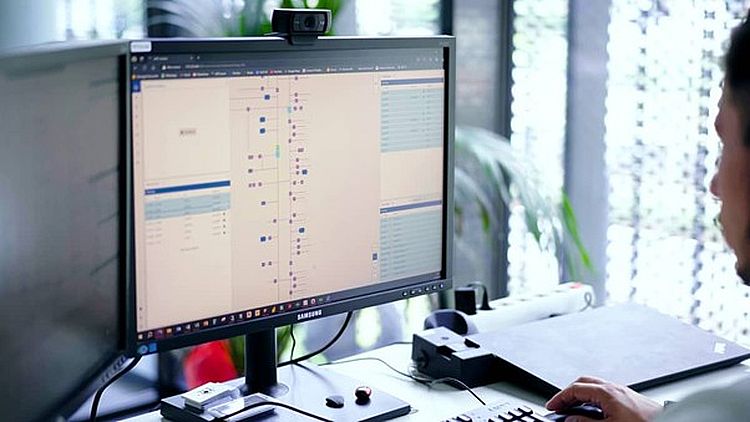
The entire fleet is managed with a single installation of ANT server. The Duka team made the decision to bring the fleet management in-house for maximum flexibility. “We decided to undergo advanced training on the ANT software to be more flexible during our working hours and to provide live service, without having to wait and without needing to communicate with suppliers or other external parties,” says Scalzo. “For example, we can change the different paths of the AGVs and make modifications to a pick-up or drop-off point for each individual box, making us independent in all our decisions within the company.”
“The software is very easy to use and thanks to constant updates from BlueBotics we can also develop new ideas within the company without needing to interface with other people, other companies, or BlueBotics. ANT server, in our case, is fully integrated into our other production systems. For example, by pressing a button on our ERP, this communicates with our WMS, which communicates with ANT server, and thanks to this system integration it can deliver the right box to the right place at the right time.
Modernized and Simplified Intralogistics
The Duka team have achieved their goal of modernized and simplified intralogistics. By automating repetitive tasks, their workforce can focus on value-adding tasks.
Gruber confirms: “Before using the AGVs, every employee had to search for their components themselves and bring them to the workstation by hand. This preparation time was therefore very long. We can now save this time because the AGVs provide the components to the workstation.”
Besides relieving workers of unnecessary labor and simplifying intralogistics, the process of automating brought other benefits. Examining every process pressed the team to improve their internal data: “Another advantage of automation was that we had to prepare all the master data and bill of materials perfectly and cleanly. Because without clean data, there is no automation,” concludes Gruber.

