
Güdel gantry robot masters extraordinary challenge
3D concrete printing - a game changer?
May 06, 2026 — Buildings directly from the printer - what was once a bold utopia a few short years ago has now become part of everyday life. Affentranger Bau AG, one of the pioneers of concrete printing, has developed this innovation, which opens up new dimensions for the construction industry, to series maturity. A key component in this system is a 3-axis gantry robot developed by the Swiss company Güdel Group AG.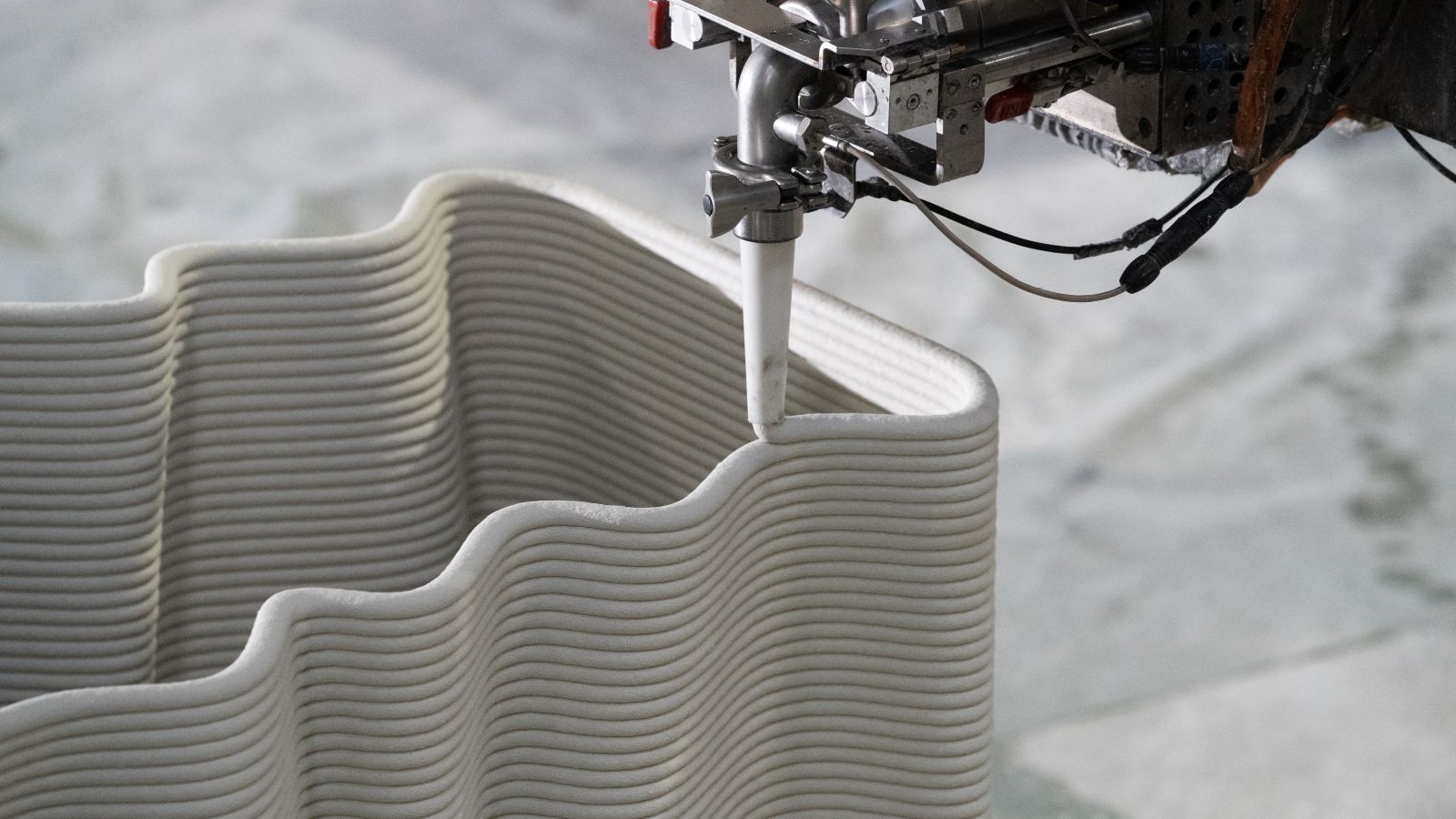
The concrete is applied layer by layer in defined paths © LCA Automation and Affentranger AG
Affentranger Bau AG was founded by Markus Affentranger and is a purely family-run company, managed in the second generation by his three sons Marius, Lukas and Gabriel. The business strategy is therefore not geared to-wards short-term profit maximization, but towards the long-term success of the company. The company is not only reacting to the material price increases and margin pressures the construction industry is currently suffering under by cutting costs but proactively seeking innovations that increase efficiency. Marius Affentranger and his two brothers recognized the potential of using 3D printing in the construction industry as a supplement to tradi-tional solid construction at an early stage. In comparison the biggest advantage lies in the strong integration of digital models. This technology can improve productivity and save material and time.
Together, it allows almost limitless design flexibility. This means that individual objects can be produced economi-cally that would not be possible with conventional concrete casting processes. These can range from smaller components such as architectural furniture and elaborately curved columns to structural components such as walls, window frames or stairs. The possibilities of 3D concrete printing are endless.
From pioneer to expert
Recognizing the advantages of a new technology is one thing, successfully implementing it is the greater art. When Affentranger AG decided to install a 3D concrete printer four years ago, it broke new ground. "We wanted to open up a new area of business with this innovation and were ready to take on this major challenge. We deliberately decided not to manufacture elements at a fixed production site, as we see the potential of concrete printing more in element construction and - at least in the medium term - less in printing finished buildings directly on the construction site," says the businessman, looking back. 3D concrete printing is a multi-layered process that can only be mastered through networked thinking. In simple terms, the system consists of a continuous mixer for material production, a feed pump, a sufficiently long pipe for connecting the pump and print head and a portal on which the print head and nozzle travel. The whole process is controlled by special software that translates the 3D computer models into a machine program. During the actual printing process, material is then applied and stacked layer by layer to produce three-dimensional objects based on digital models.
In an initial feasibility study, the company clarifies with its customers whether an object can be manufactured using 3D concrete printing technology from a technical perspective and provides input for optimization. The en-tire production process, from the creation of a 3D model and production to the appropriate logistics solution for the delivery of an object, is planned in a serious manner. Before the printing process starts, a model is created digitally and the data is then transferred to the printer using special software. At this point, another decisive factor comes into play: the material. As there was no material solution on the market that could meet Affentranger Bau AG's requirements, the company developed its own solution. The printed concrete must be easy to pump, bond firmly across the various layers during printing, quickly achieve sufficient load-bearing capacity and dimensional stability, and meet aesthetic and economic requirements. Because the concrete printed by this company has around three times the compressive and flexural tensile strength of conventional structural concrete thanks to a special fiber reinforcement, the components also have sufficient strength for use in practice. However, choosing the right printer is also crucial to ensure that everything runs smoothly.
FP-5 high-performance gantry robot from Güdel
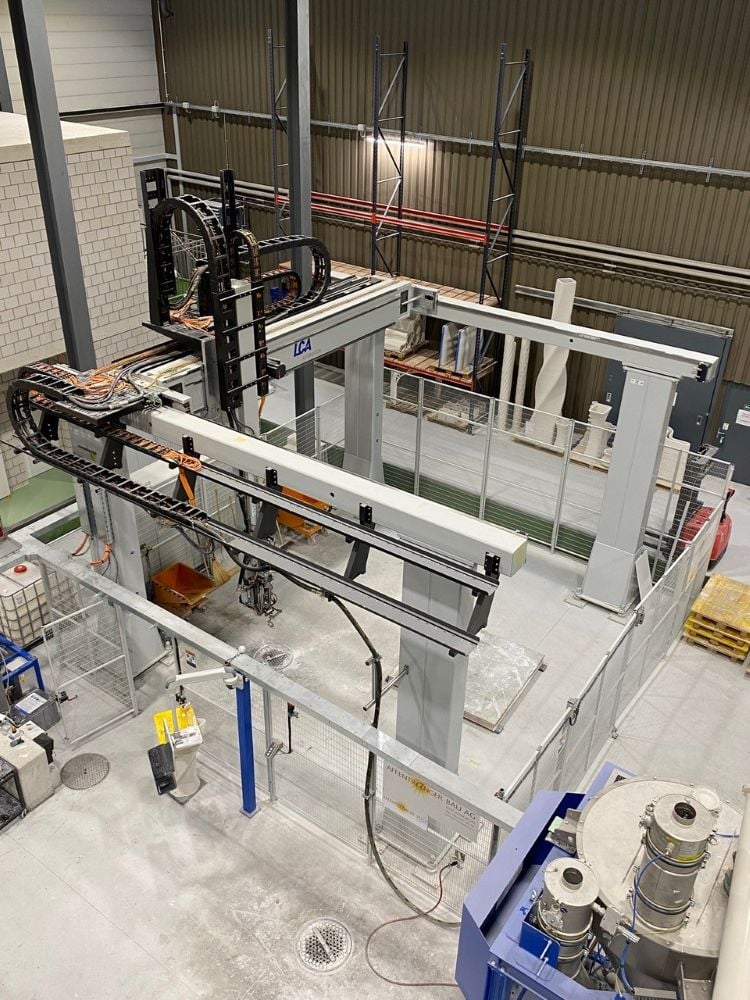
In their search for a suitable printer, Affentranger came across Güdel Group AG, based in neighboring Langenthal, via their system supplier LCA Automation AG. The Güdel Group AG is recognized worldwide as an outstanding manufacturer of high-precision gantry systems and automation solutions. The 3-axis gantry robot used stands out in particular when large work areas need to be covered with high precision and is designed for handling heavy loads. It has a modular design and currently has an area of 5 x 3.8 meters with a height of 3.5 meters. It therefore covers a cubic working area of over 65 m3. The user could adapt or extend this system as required. It is highly dynamic and works with a repeat accuracy of 0.02 mm. "This allows us to implement our high-quality require-ments effortlessly, whereby material consistency also plays a role in terms of accuracy," says Marius Affentranger. The print head moves along the horizontal supports. It can reach any position within the construction via the three axes. This allows an infinite variety of shapes to be created. This is a huge advantage, as complex shapes can be produced without any formwork. Angles of up to 40 degrees are even possible, which would be very expen-sive without this process. The high-quality components are low-maintenance and ensure the rigidity of the axes required for 3D printing with high dynamics.
An all-round positive conclusion
After four years of experience with 3D concrete printing, Marius Affentranger is fully convinced of this new tech-nology. "We purchased it not only because we want to be innovative, but above all from an economic and strate-gic point of view. It enables us to meet our customers' requirements even better. We see this process as comple-menting and expanding our range of services," emphasizes the Managing Director. Although 3D concrete printing in itself is still somewhat more expensive than conventional production, it is the more economical solution in the overall calculation, depending on the application. Because production is digitized, the quantity of printed products is not important. Individual solutions can also be produced cost-effectively. The process enables individual solu-tions, and the planner can make changes right up to shortly before printing if necessary. When it comes to the size of the components, the process is limited by logistics alone. Marius Affentranger is convinced: "3D concrete printing offers numerous advantages where it is used sensibly. In addition to the variety of shapes already men-tioned, the time factor also stands out. The elements are printed in the workshop within a short space of time and delivered to the construction site ready for use. As material is only printed where it is structurally necessary dur-ing production, less material tends to be used, and weight is saved. Marius Affentranger sees 3D concrete printing as a pioneering method for efficient and creative new and existing buildings. "If concrete printing is used sensibly, it is an important innovation for the construction industry and offers an exciting addition to conventional con-struction methods. We are currently still doing a lot of educational work on how concrete printing works and what advantages the technology offers when used in a well-thought-out way in practice. We are therefore always particularly pleased when customers come to us on site with project ideas to see the possibilities for themselves. The best ideas often arise during the ongoing process and together we will shape progress."

