
Opening doors, calling elevators, navigating to charging stations: mobile robots must do more than simply find their way whilst in operation. They must also communicate with their surroundings. Until now, this has often been a complex process. Vehicles, control systems and infrastructure components frequently come from different manufacturers and use their own interfaces. Consequently, for a project to work, individual development, testing and maintenance are often required.
This is where M2X (Machine to X) comes in. The open specification defines common rules, content and processes for the exchange of information between mobile robots and their environment. The recently published draft can be used, tested and further developed by companies, manufacturers and integrators.
Jointly developed by academia and industry
M2X was developed by the Chair of Material Handling and Warehousing (FLW) at TU Dortmund University in collaboration with the Fraunhofer Institute for Material Flow and Logistics (Fraunhofer IML). The initiative is supported by the VDMA Materials Handling and Intralogistics Association as well as industry partners. The approach thus combines scientific development with the requirements of industrial applications.
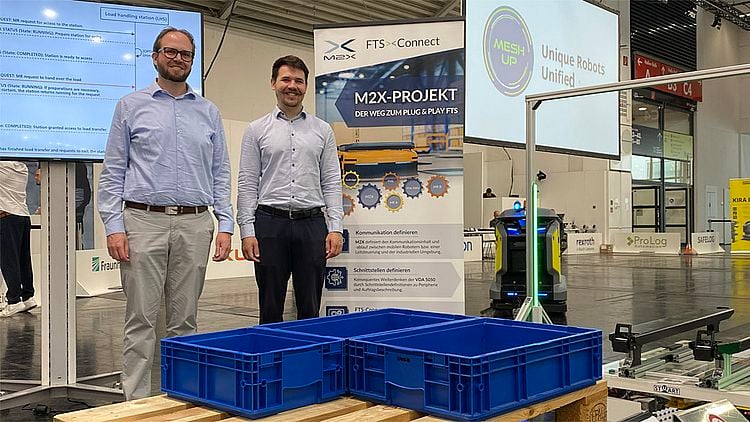
“M2X is an important step towards autonomous warehouses and production facilities. Where the necessary hardware is already in place, integration is often the stumbling block. This is where M2X comes in, to give machines a common language.” Dennis Lünsch, Fraunhofer IML
A robot does not move in a vacuum
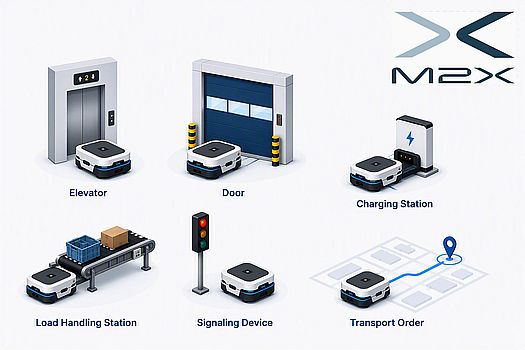
On its way through a warehouse or production facility, a vehicle must, for example, pass through a gate, use an elevator, collect materials at a load-handling station or approach a charging station. To ensure the flow of materials does not come to a standstill, the vehicle, the control system and the infrastructure must exchange the right information at the right time.
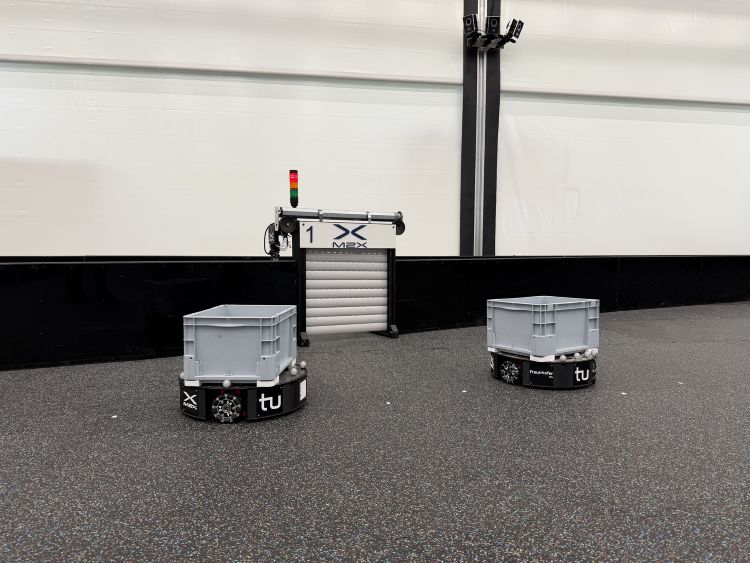
In the absence of common rules, time-consuming, project-specific solutions arise. With every additional component, the effort required for development, testing and subsequent adjustments increases. M2X is intended to create a reusable framework for this purpose. The specification is aimed, amongst other things, at doors and gates, elevators, charging stations, transport orders, signalling systems and load-handling stations.
Common rules for different systems
M2X builds on the concept of the open communication interface VDA 5050, which structures communication between a control system and multiple mobile robots. Whilst VDA 5050 already defines communication between fleet management and vehicles, M2X extends this approach to include further key areas of warehousing and other sectors. Although M2X is conceptually based on VDA 5050, it does not require its use; the interface can also be used independently of it. The harmonisation of the interfaces is intended to enable different systems from various manufacturers to work together seamlessly.
Technically, M2X relies on a middleware-neutral, publish-subscribe-based communication architecture. The specification defines the content and flow of messages, not the protocol or broker product used. Defined JSON schemas and sequence diagrams are provided for implementation. All interfaces follow a uniform structure: participants describe their capabilities via a fact sheet, whilst activities are carried out through an exchange of requests.
The openness of the concept is particularly important here. M2X does not prescribe any specific technical implementation and can be used in both centralised and decentralised fleet management architectures. Existing systems and legacy systems can thus be gradually integrated and modernised without the need for a complete replacement of the infrastructure.
Open specifications as an advantage
For operators, a familiar framework can reduce the effort that would otherwise be required to connect each individual device. Extensions are made easier because not every interface needs to be developed from scratch. Manufacturers and integrators can also draw on common communication rules, rather than starting from scratch for every project.
“Instead of developing a separate interface for each device, operators can rely on a familiar framework. This makes sites scalable and avoids dependence on individual suppliers.” Dennis Lünsch, Fraunhofer IML
Small and medium-sized enterprises in particular can benefit from the open specification. They can utilise existing knowledge and best practices, regardless of whether they carry out the integration themselves or commission an external partner.
The draft thrives on its application
The specification is publicly available via the project’s GitHub repository. Its publication therefore marks not the end, but the start of a broader testing and consultation phase. Companies and other interested parties can use the draft, share their experiences and submit suggestions for improvement.
“From now on, it all depends on the support of companies. The more who get involved, contribute and share their experiences and feedback, the better.” Sven Franke, TU Dortmund
Whether M2X becomes a widely used common language will be decided in practice. The published draft lays the groundwork for testing the rules in specific applications and developing them further collaboratively.
Further information on M2X
GitHub repository M2X: https://github.com/M2X-Project...
Press release by VDMA Materials Handling and Intralogistics Association: A Common Language for Mobile Robots and Infrastructure - vdma.eu - VDMA
Interview with Sven Franke, research associate at the Chair of Material Handling and Warehousing (FLW) at TU Dortmund University, and Dennis Lünsch, research assistant at the Fraunhofer Institute for Material Flow and Logistics, both project leaders for M2X: The path to a common language in intralogistics - vdma.eu - VDMA
About the author
Andreas Scherb
Consultant Mobile Robots
VDMA Materials Handling and Intralogistics Association
IFR Secretariat
The General Secretariat is responsible for the daily management of IFR and the coordination of all major activities, events and collaboration. The General Secretariat handles all questions regarding IFR membership.

Dr. Susanne Bieller
IFR General Secretary
Phone: +49 69-6603-1502
E-Mail: secretariat(at)ifr.org

Silke Lampe
Communication Manager
Phone: +49 69-6603-1697
E-Mail: secretariat(at)ifr.org
Credits · Legal Disclaimer · Privacy Policy ·World Robotics Terms of Usage · © IFR 2026