
My motivation for entering robotics
My curiosity about new technologies is the biggest driving force for me to enter the robotics industry.
This interest dates back to my childhood. When I was in middle school, I came across a computer training course being advertised on the street and decided to enroll on my own. Later, when choosing my major at university, I pursued this field without hesitation. Curiosity about emerging technologies and the desire to explore them have always been the driving forces behind my work.
After starting work in 1997, I explored e-commerce website development, intelligent transportation systems, among others. In 2000, under the guidance of my laboratory director, I was introduced to robotics. I was immediately fascinated by this new field and soon devoted myself fully to research. I started with robotic soccer, leading students to achieve strong competition results, while constantly thinking about a more fundamental question: if robots are to move beyond competitions and demonstrations, what technical challenges must be solved for them to become truly useful?
With this question in mind, I gradually shaped my research direction, focusing on core areas such as SLAM, humanoid robotics, and robot manipulation learning. From theoretical study and algorithm development to full system integration, I worked to transform abstract technologies into practical and deployable robotic systems through continuous iteration and refinement.
To me, the appeal of robotics does not lie in a single algorithmic breakthrough, but in the deep integration of mechanics, control, perception, and intelligence. It is technically challenging, yet closely connected to real societal needs. Bill Gates once predicted that every household would have a robot in the future. This belief strengthened my conviction that robotics will move from research papers and competitions into real-world applications in homes and industries. I have remained committed to contributing to that transition over the long term.
What inspires me in the field
What continues to motivate me is a fundamental challenge in robotics that has not yet been fully solved: how to move robots from demonstration systems to reliable, general-purpose tools capable of long-term independent operation in real environments.
The real difficulty lies in enabling robots to accurately understand task requirements, execute actions reliably across different scenarios, and remain stable as conditions change. Achieving this requires not only advances in algorithms but also strong system design and engineering capability. Working toward this goal continues to drive my long-term commitment to robotics.
At the same time, I have always believed that robotics and engineering should not be limited by gender. In my view, curiosity, capability, and persistence matter far more than gender differences. Women should not feel constrained by predefined expectations or traditional roles when choosing a career. As a professor and team leader, I actively encourage more women to enter the robotics field. By sharing my own experiences, I hope to inspire my students—especially female graduate students—to build confidence and pursue long-term research and innovation.
My career path
I received my Bachelor’s degree in 1994, my Master’s degree in 1997, and my Ph.D. in Control Science and Engineering in 2009, all from Zhejiang University. Since 1997, I have been a faculty member at Zhejiang University, where my research has focused on intelligent robot mobility and manipulation. My team was among the early research groups in China to integrate artificial intelligence with robotic systems and to validate these technologies in real-world applications.
In 2011, I led the development of the humanoid robots “Wu” and “Kong,” which can play dynamic table tennis rallies. This work attracted international attention and was cited by the U.S. National Science Foundation in a report submitted to the White House. While the project demonstrated advanced technical capabilities, it also made me reflect on the gap between laboratory demonstrations and real operational environments. Since then, I have consistently emphasized that robotics research should be driven by practical needs and real-world deployment.
Through long-term collaboration with partners in manufacturing, aerospace, and logistics, my research outcomes were gradually translated into engineering systems and industrial applications. Based on this experience, I co-founded Hangzhou IPLUSMOBOT, where I serve as Co-founder and Chief Scientist. The company focuses on autonomous mobile robots for industrial logistics and has become one of the leading providers of natural navigation AMR systems in China. It generates annual revenue of around USD 50 million and holds approximately 5% of the global AMR market. Its products are deployed not only in China, but also in Japan, South Korea, Europe, North America, and the Middle East, serving industries such as semiconductors, electronics, automotive, and energy.
In 2023, I co-founded Zhejiang Humanoid Robotics Innovation Center Ltd., building on my experience in industrial applications. The firm focuses on embodied intelligence, robot software, and industry-oriented solutions. It aims to create an integrated platform that combines research and development, technology transfer, talent cultivation, and large-scale deployment. Several milestones have been achieved, including the first deployments of humanoid robots in garment manufacturing, multi-component automotive assembly, and long-term operation in laboratory environments, as well as applications in power grid inspection, industrial production lines, retail services, and overseas factories.
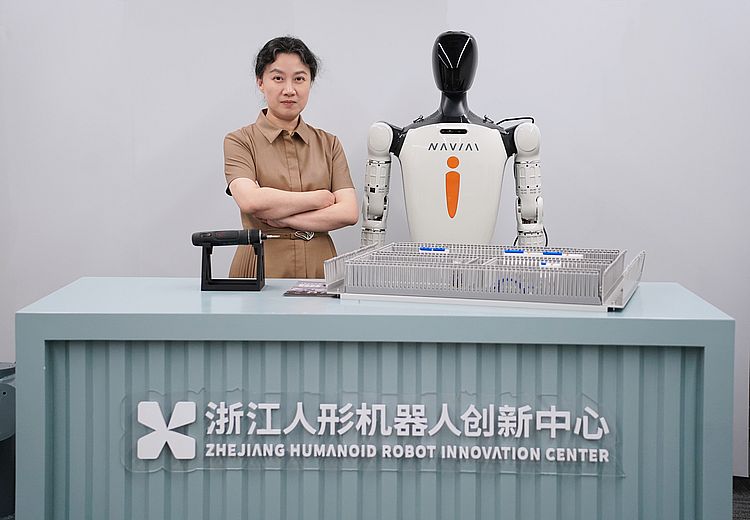
Alongside entrepreneurial work, I have continued my academic research. As a Qiushi Distinguished Professor at Zhejiang University, my work has contributed to robust balance control for legged robots, reliable localization and navigation for mobile robots, and high-precision, high-efficiency robot manipulation. I have published nearly 200 papers in leading international journals and conferences, including Science Robotics, Nature Communications, The International Journal of Robotics Research, IEEE Transactions on Robotics, TPAMI, TITS, TMECH, TIE, as well as ICRA, IROS, and CVPR. I hold three international invention patents and more than sixty Chinese invention patents, and have led over twenty national and provincial research projects, including major programs under the “New Generation Artificial Intelligence” initiative and key projects funded by the National Natural Science Foundation of China.
I have also remained committed to education and talent development. In 2001, I initiated the Robotics Education and Practice Base at Zhejiang University, promoting the integration of theory and hands-on innovation and helping to build a comprehensive robotics curriculum. In 2019, I led the establishment of the undergraduate program in Robotics Engineering at Zhejiang University. Many of my former students have become key contributors in academia and industry, and several have founded well-known robotics companies.
About the author
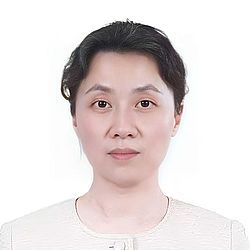
Professor Rong Xiong
Cofounder and Chief Scientist
IPLUSMOBOT / Zhejang University, China
IFR Secretariat
The General Secretariat is responsible for the daily management of IFR and the coordination of all major activities, events and collaboration. The General Secretariat handles all questions regarding IFR membership.

Dr. Susanne Bieller
IFR General Secretary
Phone: +49 69-6603-1502
E-Mail: secretariat(at)ifr.org

Silke Lampe
Communication Manager
Phone: +49 69-6603-1697
E-Mail: secretariat(at)ifr.org
Credits · Legal Disclaimer · Privacy Policy ·World Robotics Terms of Usage · © IFR 2026