
In 1991, when industrial robots were rapidly being introduced into manufacturing sites throughout Japan, I joined Kawasaki Heavy Industries and was assigned to the Robotics Division.
Although my academic background was in radio engineering, my initial assignment involved software development for industrial robot control systems. I learned my first programming language after joining the company, and through continuous trial and refinement, I gradually experienced the professional satisfaction of seeing robots operate increasingly in line with their intended behavior.
Industrial robots constitute essential equipment within customers’ production facilities, and any downtime can have a significant impact on manufacturing operations. This reality entailed a considerable sense of responsibility. Nevertheless, the experience of witnessing dozens of robots operating simultaneously on site—driven by software I had developed—was profoundly rewarding. Through these experiences, I came to recognize the critical importance of software in robotics, and I devoted myself fully to my work in this field.
Subsequently, following marriage and childbirth, I took childcare leave. Shortly after returning to work, I gave birth to a second child and again took childcare leave, resulting in a period characterized by repeated interruptions to my professional activities.
At that time in Japan, although the Equal Employment Opportunity Law had already been enacted, workplace systems and organizational awareness regarding gender equality were still insufficient. Few women continued working while raising children, and it was commonly assumed that women would leave their jobs upon marriage or childbirth. I, too, faced such expectations.
At the same time, several years had passed since I joined the company, and I had begun to take a more proactive role in coordinating specifications directly with customers and independently advancing software development projects. I was unwilling to relinquish the professional fulfillment of this work or the expertise I had accumulated, and I therefore chose to continue my career in robotics.
For some time after returning to work, balancing professional responsibilities and childcare proved challenging. Business travel was difficult while my children were young, and when they became ill and were unable to attend daycare, there were periods during which I could not come to the office for several days. I often struggled with feelings of self-doubt, questioning whether I was placing an undue burden on those around me or whether leaving my position might be the more appropriate course of action.
Despite these difficulties, I was able to continue working in robotics thanks to the understanding and support of my supervisors, colleagues, and family. Colleagues frequently took on-site responsibilities in my absence, and their cooperation was instrumental in enabling me to remain in my role. One remark from a supervisor at the time has remained particularly meaningful to me: that working while raising children is not an individual issue, but a challenge that society as a whole must address and support.
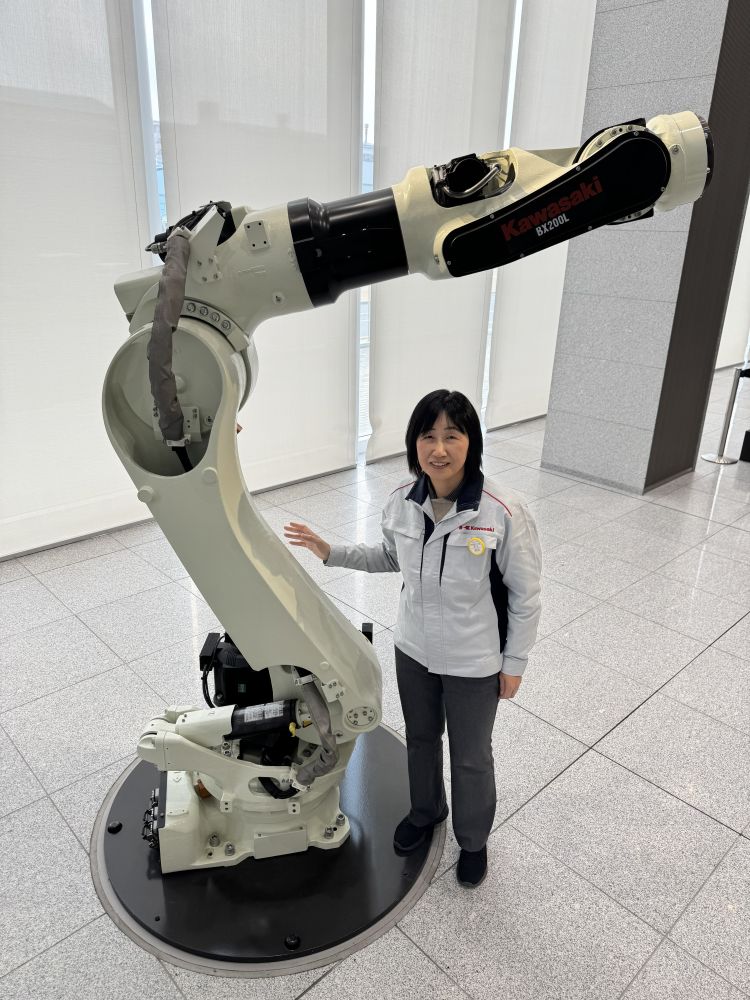
Through the continuation of my professional career, I have accumulated extensive experience and technical expertise. I have been involved in numerous development projects in collaboration with customers, aimed at improving quality and productivity. These have included enhancements to welding performance and cycle time in spot-welding robots, as well as the development of systems for collecting and utilizing welding data. Such experiences have become invaluable professional assets.
Today, I am in a position to pass on the knowledge and skills I once learned from senior colleagues to the next generation, providing guidance and advice. I hope to support those who, as I once did, continue working while facing uncertainty and challenges, so that they may build long and sustainable careers in the field.
To those who are considering a future in robotics, I would encourage you to value those moments in your work that you find genuinely engaging and worth pursuing, even when you encounter doubts or difficulties. By moving forward steadily with the support of those around you, opportunities will continue to expand.
I firmly believe that enabling people with diverse backgrounds to contribute in their own ways will enrich the future of robotics and strengthen the field as a whole.
IFR Secretariat
The General Secretariat is responsible for the daily management of IFR and the coordination of all major activities, events and collaboration. The General Secretariat handles all questions regarding IFR membership.

Dr. Susanne Bieller
IFR General Secretary
Phone: +49 69-6603-1502
E-Mail: secretariat(at)ifr.org

Silke Lampe
Communication Manager
Phone: +49 69-6603-1697
E-Mail: secretariat(at)ifr.org
Credits · Legal Disclaimer · Privacy Policy ·World Robotics Terms of Usage · © IFR 2026