
Automation is transforming the nature of work across industrialized economies. As new technologies are adopted, tasks are reallocated between workers and machines. Whereas research has focused on the aggregate employment effects of automation, little is known about how automation changes existing jobs. The adoption of new technologies changes both which occupations are in demand and what workers in these occupations do.
Unexpected changes in skill demand
We find that automation increases the demand for soft skills, such as coordination and judgment, among managers and professional workers. This may come as a surprise, since one might expect more technical skills, such as operating tools, to be affected. Our conceptual framework explains these changes: automating work tasks increases the demand for skills related to complementary activities that are harder to automate. Workers whose tasks are not directly automated can therefore still see their jobs change. These changes are particularly pronounced in occupations that work closely with those directly affected, such as managers and professionals.
Among the workers most directly affected by automation, those in production and elementary occupations, we see two margins of adjustment. First, firms reduce employment in these occupations, primarily through reduced hiring rather than increased dismissals. Second, workers in automating firms are re-equipped with relevant skills, as shown by a 15% increase in participation in retraining courses.
Automation transforms what occupations do
Most research in the field has focused on changes in skill demand as captured by shifts in demand across occupations. This misses a key channel through which automation reshapes skill demand: within-occupation change. This concept captures the fact that the tasks workers perform within an occupation, and therefore the skills their work requires, change over time. Indeed, a metalworker today uses a very different skill set from one 50 years ago.
Separating the two channels, we find that the within-occupation channel accounts for 45–93% of the total change in skill demand caused by automation, depending on the skill and occupational group considered (see Figure).
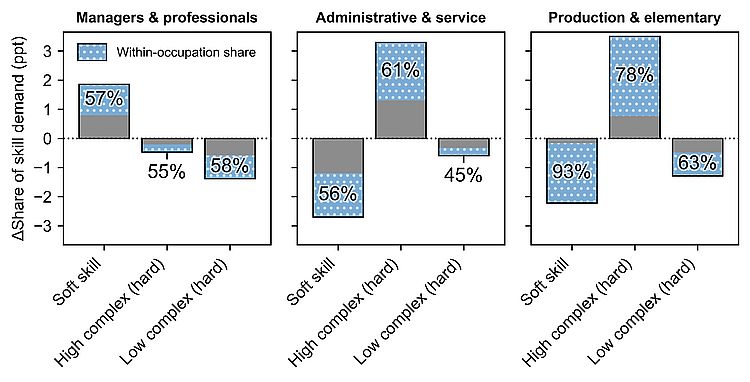
Combining Danish job vacancy skill requirements with machinery investments
The study was made possible by a novel combination of Danish administrative data and vacancy postings. Most importantly, the administrative data show which firms automate and when, identified through large investments in machinery, which we call automation events. Data covering all individuals in the Danish economy also provide information on employment and participation in adult vocational training. Using natural language processing, we extract skill requirements from the vacancy postings of automating firms and categorize them into soft skills, high-complex hard skills (typically learned at university) and low-complex hard skills (practical, job-specific skills).
Implications for firms and policy
Taken together, automation changes demand for skills among occupations and skills that one might not intuitively expect to be affected. Within-occupation change accounts for a large share of changes in skill demand, offering an opportunity for policy makers to equip workers with the key skills needed to adapt within their occupation. Denmark’s extensive system of adult education is a key channel through which workers can acquire these skills. For firms, the results suggest that investing in machinery also means rethinking the skills asked of managers and professionals and the training offered to production workers.
Co-authors:
Giuseppe Pulito
Sarah Schroeder
Full working paper titled “Automation and the Changing Composition of Skill Demand” available at:
https://papers.ssrn.com/sol3/p...

About the author
Mark Hellsten
University of Tübingen
IFR Secretariat
The General Secretariat is responsible for the daily management of IFR and the coordination of all major activities, events and collaboration. The General Secretariat handles all questions regarding IFR membership.

Dr. Susanne Bieller
IFR General Secretary
Phone: +49 69-6603-1502
E-Mail: secretariat(at)ifr.org

Silke Lampe
Communication Manager
Phone: +49 69-6603-1697
E-Mail: secretariat(at)ifr.org
Credits · Legal Disclaimer · Privacy Policy ·World Robotics Terms of Usage · © IFR 2026